
Introduction: there is no universal winner for every lotion
Choose between gear pump and piston filling by testing the actual emulsion at its intended filling temperature, dose and bottle format. Compare dose consistency, product condition, nozzle shutoff, cleaning and accepted line output. Viscosity alone cannot establish that one filling principle is suitable and the other is unsuitable.
Lotions and emulsions can be thin, thick, foaming, shear-sensitive or temperature-dependent. Two products described as “body lotion” may therefore need different handling. A purchase decision based only on a viscosity label or a demonstration with water can miss the behavior that determines production success.
This guide explains the comparison for cosmetics manufacturers, private-label producers and overseas equipment buyers. It also uses COTECH proposal F20261010-2A to show how a filling decision fits into a bottle line. That proposal describes a planned configuration; it is not presented here as a completed installation or a measured performance result.
1. Understand what each filling system meters
Gear pump filling
A gear pump moves product through the spaces associated with rotating gears and the pump housing. A filling system may control the delivered quantity through calibrated rotation, time or a configured measurement arrangement. Ask how the quoted equipment establishes each dose, which settings are adjustable and whether a sensor or weighing feedback is included.
Product viscosity, pump speed, inlet conditions, pressure and internal clearances affect actual delivery. A calibrated setting should be evaluated with the intended formulation, not assumed to hold for every recipe. Start and stop behavior also matters because the product must be delivered through a nozzle into a finite container.
Piston filling
A piston filler draws product into a cylinder and discharges it through the configured valve and nozzle arrangement. Cylinder geometry and effective stroke determine the displaced volume. Filamatic's piston filler explanation describes this relationship between stroke and cylinder dimensions. Actual suitability still depends on product feeding, valves, seals and the complete filling configuration.
Ask which cylinder sizes cover the planned range and whether a particular dose requires multiple strokes. A different cylinder or valve arrangement may be appropriate for a different formulation. A general claim of versatility does not establish that every product, particle size or cleaning procedure is supported by a specific machine.
2. Prepare a formulation brief before comparing quotations
Begin with the product's behavior under real filling conditions. Identify the emulsion type if known, relevant ingredients, expected temperature range and any concerns about separation, aeration or changes in texture. Confidential recipe details can be handled through an agreed process, but the supplier still needs enough information to evaluate the application.
Viscosity needs a measurement condition
A viscosity value without temperature and test method is difficult to interpret. Many lotions are non-Newtonian, so the apparent viscosity can depend on the applied shear and measurement conditions. Share the instrument or method, temperature and relevant settings rather than writing only “thick cream” in the enquiry.
Describe how the product changes during normal production. It may enter the tank warm and become more viscous as it cools, or contain air after mixing. Ask whether the trial should include the expected extremes rather than only the easiest condition. A supplier cannot responsibly infer these details from a product photograph.
List particles, sensitivity and cleaning chemicals
If the formulation contains beads, suspended solids or abrasives, specify their size and behavior. Pump and valve passages must be evaluated against them. Explain any sensitivity to pumping, recirculation or mixing, and identify how product quality will be checked before and after the trial.
Provide the cleaning agents, concentrations, temperatures and contact times that the site intends to use. Material suitability depends on the complete exposure conditions. Terms such as cosmetic-grade or food-grade should not replace a documented review of the selected contact materials and cleaning procedure.
3. Compare practical application questions side by side
| Factor | Gear pump configuration | Piston configuration |
|---|---|---|
| Dose control | Confirm calibrated rotation, time or measurement method | Confirm cylinder size, stroke control and number of strokes |
| Product behavior | Evaluate inlet supply, speed, pressure and sensitivity | Evaluate cylinder filling, valves and discharge behavior |
| Particles | Check permitted size, clearance and wear considerations | Check valve and nozzle passages plus particle handling |
| Changeover | Inspect pump access, retained product and contact parts | Inspect cylinder, seals, valves and contact parts |
| Evidence | Trial the intended recipe and bottle conditions | Trial the intended recipe and bottle conditions |
A useful comparison therefore needs more than a list of general advantages. Request a description of the proposed wetted path, the measuring principle and the changeover procedure. Ask which capabilities are standard, which require different components and which have not yet been confirmed for your product.
A gear pump is not automatically limited to water-thin liquids, and a piston filler is not automatically the answer for every thick lotion. The Viking Pump application information for creams illustrates that selected gear pump configurations can handle cream applications. That general pump guidance does not establish performance for a particular COTECH bottle filler.
4. Check shear, temperature and product condition
For an emulsion, handling quality matters alongside dose repeatability. Determine whether pumping changes appearance, texture, viscosity or visible air content under the tested conditions. Agree the evaluation method with the product owner's technical team. A machine operator's visual impression alone may be insufficient for a sensitive formulation.
Viking Pump's discussion of gear pump applications explains why operating speed is relevant when evaluating sensitive or difficult products. Use that principle to ask about the selected pump and conditions, rather than treating all gear pumps as equally gentle or equally damaging.
Temperature control may affect both product behavior and delivered mass for a volumetric dose. Discuss the tank, transfer route, hoses and nozzle together. If heating, cooling or agitation is proposed, ask what is included, how it is controlled and which conditions must be maintained by the customer's upstream process.
Do not judge product integrity from fill weight alone
Correct net weight does not establish that an emulsion remained unchanged. Compare relevant product samples before and after the agreed handling sequence. If the trial uses repeated recirculation, record it because the exposure differs from a single pass. Stability claims remain the responsibility of the appropriate product testing program.
5. Evaluate the dose range and nozzle behavior together
State the smallest and largest target quantities, with units and acceptable limits. When a label specifies volume but a trial uses weighing, agree how density and temperature are handled. Do not silently treat grams and milliliters as interchangeable, especially for aerated or temperature-dependent formulations.
Test relevant bottle openings and fill heights. A nozzle that behaves well in a wide jar may splash or contaminate the neck of a narrow bottle. Ask about nozzle movement, shutoff, drip control and any suck-back arrangement proposed for stringing products. Confirm whether adjustment affects product aeration or cycle timing.
Observe the first fills after a stop and the final fills before a tank refill. Record each head separately on a dual-head machine. A combined average can hide a consistent difference between heads. A useful acceptance plan specifies sampling conditions, measuring equipment and how adjustments are documented.

6. Compare cleaning access and contact materials
Review the entire wetted path, including tank, transfer equipment, hoses, pump or cylinder, valves and filling heads. Ask how retained product is drained and where operators must disassemble components. A small metering unit can still be part of a line with substantial product hold-up elsewhere.
Inspect the work involved in changing between formulations, colors or fragrances. Define the cleaning procedure before comparing changeover times. A supplier's demonstration of removing one component does not establish the time needed for draining, cleaning, inspection, drying, reassembly and release under the customer's procedure.
Ask about seal and hose compatibility with both product and cleaning agents. Stainless steel is only one part of the materials question. Elastomers and plastics also need review, and their suitability may change with temperature or chemical exposure. Document the approved specification rather than relying on a broad description such as corrosion-resistant.
Separate cleanability from validated cleaning
A design can offer good access without automatically satisfying a particular cleaning validation requirement. If automated cleaning is proposed, define the route, operating conditions and verification method. If manual cleaning is required, identify removal instructions, inspection points and replacement parts. Keep formal hygiene or regulatory claims tied to applicable evidence.
7. Read a real proposal as a configuration, not a performance guarantee
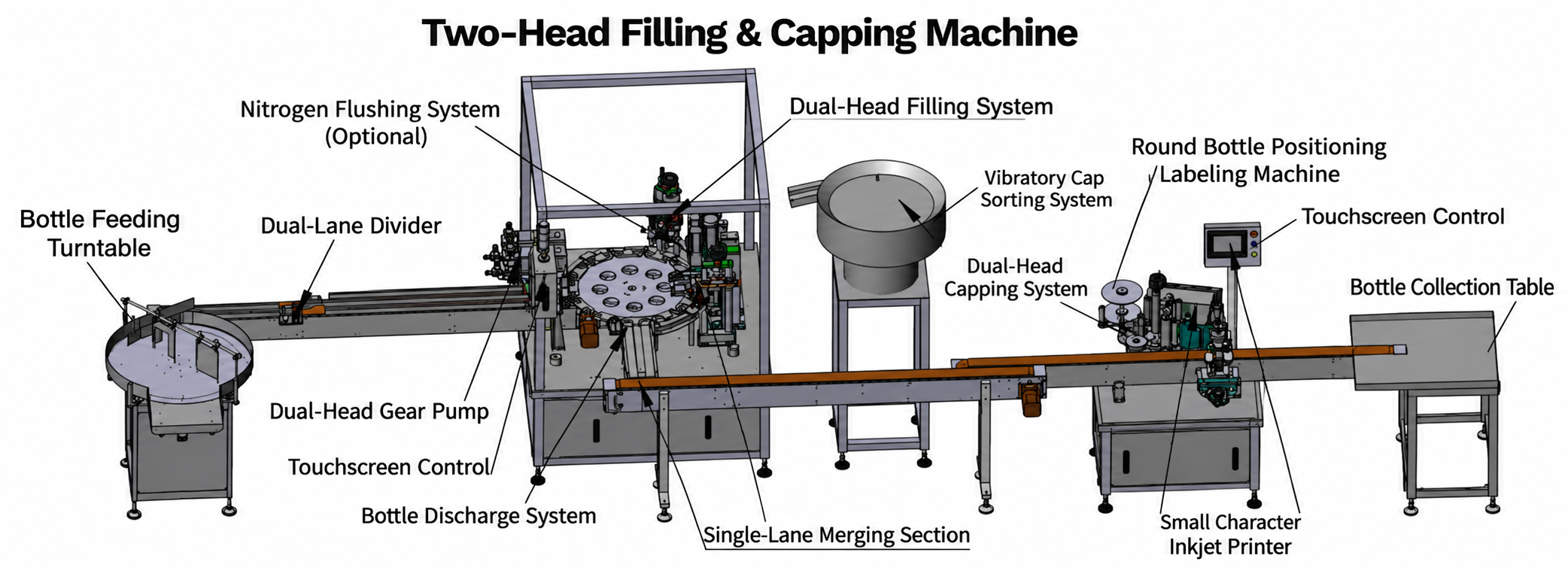
COTECH's liquid filling machine page describes proposal F20261010-2A for an oil-and-water emulsion. Bottles enter from a rotary feeding table and divide into two lanes before the integrated dual-head filling and capping unit. The proposed metering arrangement uses gear pumps.
The planned sequence includes cap sorting, dual-head servo capping, merging into one lane, round-bottle positioning labeling, small-character inkjet coding and bottle collection. Optional nitrogen flushing depends on the customer's supplied nitrogen source. These details explain the line concept; they do not establish output, dose range or product stability.
The proposal lists 304 stainless steel for the gear pumps, transfer pump, product tank, valves and filling heads; PEEK gears; EPDM flexible hoses; and PTFE valve sealing components. It specifies 230 V, 50 Hz. Treat these as proposal details that require review against the buyer's recipe, cleaning conditions and installation site.
The published proposal does not state a verified speed, fill range or dosing accuracy. Those values should be agreed through the project specification and relevant testing. It would be misleading to borrow a performance figure from another manufacturer's pump and present it as the output of this line.
8. Compare the complete line's accepted output
Filling capacity is useful only when the rest of the line can handle the same product and container. Cap feeding, capping dwell, labeling, coding and bottle collection may constrain accepted output. Ask whether the quoted number refers to filling cycles, bottles presented or acceptable finished bottles.
For planning, calculate the required accepted bottles against the actual available production time. Then discuss the container mix, changeovers and downstream process. Avoid assuming that two heads always deliver exactly twice the useful output of one head; indexing and other line operations also affect the cycle.
During installation preparation, confirm utilities, footprint, service clearance and access for product loading. The example proposal's 230 V, 50 Hz supply is not a universal site standard. A buyer in another market should have the required electrical configuration reviewed before ordering and before shipment inspection.
9. Request a trial that supports the purchasing decision
Agree a protocol covering representative formulation, temperature, dose, bottles and closures. Include stable running, stop and restart, product replenishment and the agreed cleaning or changeover demonstration. Record settings and collect head-specific measurements. Compare product condition using the buyer's defined checks.
If comparing gear pump and piston options, identify differences in trial conditions rather than ranking unmatched demonstrations. The relevant question is which proposed configuration meets the application's agreed requirements. Use the factory acceptance test checklist to organize evidence, open items and shipment readiness.
Keep an acceptance record that distinguishes confirmed results from future options. Retain relevant samples and identify the configuration used to produce them. That record supports a clearer handover than a short machine video accompanied by an unexplained accuracy percentage.
10. Shortlist proposals using evidence and open questions
If both configurations appear technically plausible, compare them against the same product brief and acceptance plan. Check included contact parts, required change components, maintenance access and operator tasks. A lower initial price may cover a narrower scope; a more complex system may add capabilities the buyer does not need.
Ask each supplier to identify the assumptions behind its proposal. These might include stable product temperature, consistent bulk supply or a specified bottle geometry. Convert critical assumptions into trial conditions or customer responsibilities. Keep an unsupported accuracy or capacity figure out of the final comparison until its basis is clear.
Where neither trial meets the application requirements, reconsider the proposed configuration rather than forcing a choice between unsuitable options. The buyer's objective is a practical filling process for its product, supported by clear evidence and a workable handover.
Frequently asked questions
Is a gear pump or piston filler better for body lotion?
Neither is universally better. Compare the actual formulation at its filling temperature, target quantity and bottle format. Review sensitivity, nozzle behavior, cleaning and line output as well as dosing. The correct decision is the configuration that meets agreed application requirements with suitable evidence.
Can gear pumps fill thick creams?
Selected gear pump configurations can handle cream applications, but that does not mean every model suits every cream. Inlet supply, temperature, speed, pressure, clearances and formulation sensitivity need evaluation. Request a relevant trial rather than using viscosity alone as an approval rule.
Are piston fillers always suitable for products with particles?
No. Particle size, hardness, concentration and fragility must be compared with the valves, passages and nozzle arrangement. A piston principle does not remove those constraints. Specify the particles and the acceptable handling outcome before the supplier confirms a proposed configuration.
Does a volumetric filler need density information?
Density matters when comparing a volume setting with measured mass or a weight-based acceptance limit. Temperature and entrained air may change the relationship. Agree the measurement conditions and tare procedure, and use clear units in the quotation and test protocol.
Can water testing replace a lotion trial?
Water can demonstrate selected mechanical functions, but it cannot establish the lotion's foaming, stringing, pumping or shutoff behavior. Record the limitation if a substitute is used and define the product testing still required. Do not infer final application performance from a clean-looking water demonstration.
What should we send when requesting an emulsion filling line?
Send formulation behavior, viscosity measurement conditions, filling temperature, dose range, bottle and cap drawings or samples, accepted output target and cleaning requirements. Include destination utilities and any inspection expectations. If specifications are incomplete, identify them as open questions rather than filling the gaps with assumptions.
Conclusion: select the tested configuration
Gear pump and piston filling should be compared as complete configured systems handling a defined product. For emulsions and lotions, the deciding evidence includes dose consistency, product condition, nozzle control, cleaning and accepted bottle output. A viscosity category alone cannot replace that evaluation.
Use a detailed application brief to start the discussion, then agree what the supplier will demonstrate before shipment. A transparent proposal explains its materials, sequence and options while keeping unverified performance claims open for testing.
Discuss your emulsion filling application
Send COTECH your formulation characteristics, filling temperature, target dose, bottle and cap samples, and cleaning requirements. Ask for a proposed configuration and an agreed product trial before confirming performance.
Get a Quote