
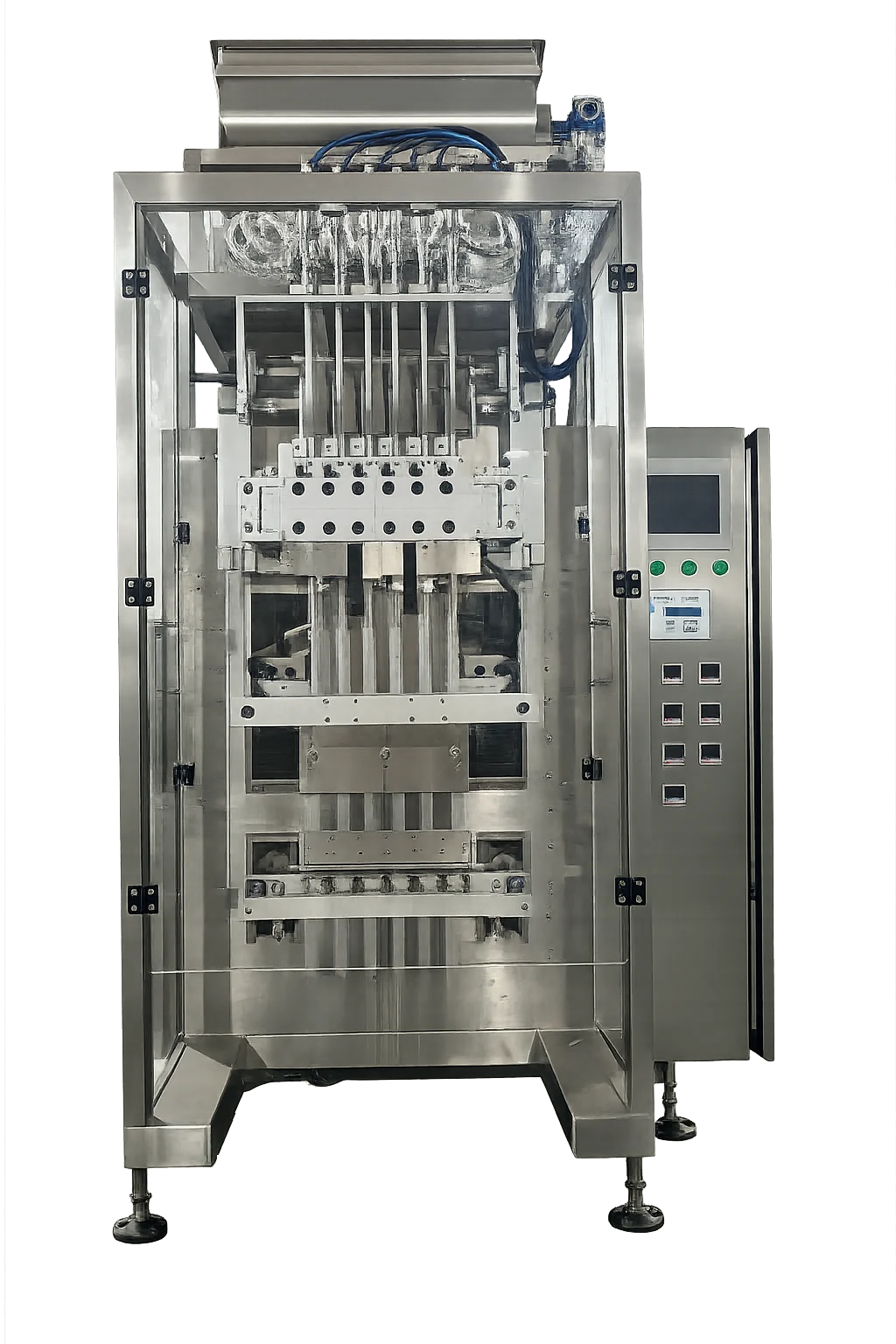
Introduction: start with accepted packs per shift
To size a multi-lane stick pack machine, calculate the accepted sticks you need during available production time, then compare that requirement with documented output for your product, film and pack size. Lane count is one input. Dosing, sealing, changeovers, inspection and downstream packing determine whether the capacity is usable.
Buying a machine with more lanes can increase the number of sticks formed in parallel, but it does not automatically solve a production bottleneck. A brand may have ample primary packaging capacity and still miss its carton target because finished sticks wait for counting. A contract packer may lose more time to frequent cleaning than it gains from a higher nominal cycle rate.
This guide helps overseas procurement, engineering and operations teams build a capacity requirement before comparing quotations. It uses transparent planning examples, rather than presenting assumed numbers as COTECH specifications. The aim is to connect customer requirements to a testable production configuration.
1. Understand lanes, cycles and total machine output
A lane is a parallel forming and filling path. In a configured machine, several lanes may produce sticks during the same cycle. Ask how the supplier defines the quoted speed: cycles per minute, sticks per lane per minute or total sticks per minute. Those quantities cannot be compared without their units and conditions.
For a simplified illustration, six active lanes at 25 cycles per minute would produce a theoretical 150 sticks per minute if each lane delivers one stick per cycle. These numbers describe arithmetic only, not an available COTECH model. They do not account for interruptions or unacceptable packs.
Verify which lanes and formats are included
Confirm the actual lane configuration offered for the required stick width and film arrangement. Discuss forming components, dosing positions and change parts. A catalog photograph may show one configuration while the quotation describes another. Get the pack dimensions and active lane count into the technical specification.
Also distinguish a machine's mechanical maximum from the agreed running condition. A particular formulation may require slower dosing or a longer sealing interval. A demonstration using another product or shorter stick does not establish the required output for your commercial application.
2. Translate commercial demand into a packaging brief
Start with the unit the business sells, then convert it into sticks. If demand is expressed as retail cartons, specify the stick count per carton. If it is expressed as kilograms of bulk product, specify the portion weight. Include the mix of products and formats rather than combining unlike orders into one headline total.
- Accepted sticks required per shift, week and peak order period.
- Stick count per carton or outer bag, including promotional formats.
- Product identities, target portions and relevant physical behavior.
- Stick dimensions, film specification and coding requirements.
- Number of shifts, planned operating days and available staffing.
- Expected batch sizes, changeovers and downstream packing method.
Separate ordinary demand from a short seasonal peak. A recurring high-volume requirement may justify a different configuration from an occasional promotion. Explain how the business expects to handle peak orders, whether through longer operation, inventory preparation or future equipment expansion.
A demand calculation example
Suppose a buyer needs 2,000 cartons containing 20 sticks each. That is 40,000 accepted sticks. With 320 minutes allocated to producing those sticks after the buyer's planned setup and cleaning allowance, the requirement is 125 accepted sticks per allocated minute. This is a hypothetical customer schedule, not a machine performance claim.
3. Define production time without counting losses twice
Capacity calculations become misleading when time boundaries change between quotations. An eight-hour shift does not necessarily provide eight hours of packaging. Breaks, sanitation, product preparation, format changes and staffing can reduce the window available to the line. List those assumptions before applying a speed figure.
Choose a consistent denominator. One approach compares accepted output with the entire scheduled production window and records all interruptions within it. Another builds a smaller planned running window by removing defined activities first. Either can support planning, but the same loss should not be deducted from time and then deducted again through an efficiency factor.
Use your own loss assumptions
The Lean Enterprise Institute's explanation of overall equipment effectiveness separates availability, performance and quality losses. This provides useful terminology, but a published OEE formula does not supply a realistic percentage for a new stick pack application. Agree the boundaries and use site data or documented trial evidence.
For a new line, show uncertain assumptions as uncertain. A capacity sheet might include a conservative planning scenario and a tested scenario once factory testing is complete. Do not describe an invented utilization factor as an industry guarantee or quietly use the supplier's best demonstration as a full-shift forecast.
4. Identify what limits the cycle for your product
Powders and granules
Powder flow, dosing volume, settling and discharge timing can influence the running condition. A low-density powder may occupy more space than another product at the same weight. Dust near a seal can turn otherwise satisfactory dosing into rejected output. Review the product and the pack together.
Granules raise different questions about particle size, flow and damage. Ask how the proposed dosing and transfer arrangement handles them. A powder trial should not be treated as evidence for a granule application solely because both products are dry. The intended material still needs its own assessment.
Liquids and semi-liquids
For liquids, filling time, foaming, stringing and nozzle shutoff can affect the cycle. Temperature-dependent products may behave differently as the supply tank empties or cools. Ask whether the planned output remains achievable across the agreed operating conditions, rather than only during the easiest portion of a demonstration.
Pack length, printed registration and the film's sealing behavior can also constrain operation. Increasing the commanded machine rate can create more rejects if the package no longer seals consistently. The production target is accepted output, so review seal and coding results beside the speed setting.
5. Check consistency across every lane
A multi-lane machine needs a sampling plan that identifies individual lanes. Record net fill quantity using an agreed tare method, seal condition, coding and relevant dimensions. An overall mean can appear acceptable while one lane repeatedly underfills or creates a tracking problem.
Discuss the response to a lane-specific fault. Can operation continue in an agreed reduced configuration, or does the entire machine stop? How are rejects separated and recorded? The answer depends on the quoted design and control arrangement; do not assume independent lane operation is a standard feature.
| Question | Useful record |
|---|---|
| What was running? | Product batch, dose, film and stick dimensions |
| How fast? | Cycle setting, active lanes and total produced units |
| How many were accepted? | Accepted count, reject count and agreed defect limits |
| What interrupted the run? | Elapsed time, stop reasons and operator interventions |
| Were all lanes satisfactory? | Measurements and observations identified by lane |

6. Convert stick output into downstream demand
The line does not finish its task merely because sticks leave the cutting station. They may need inspection, counting, grouping, insertion into cartons, coding or case packing. Convert the primary machine's required output into the unit handled at each subsequent stage.
For example, 125 accepted sticks per minute grouped into 20-stick cartons represents 6.25 cartons per minute on average. This is a planning conversion, not a cartoner specification. The downstream process also needs to handle uneven arrivals, replenishment and rejects without losing count or damaging packs.
Review accumulation and recovery
Ask what happens when the downstream stage stops briefly. A buffer can provide time to respond, but its useful capacity depends on pack handling and the configured control logic. Define how the system prevents overflow and resumes production. Do not assume a conveyor alone provides a controlled accumulation function.
If manual collection is proposed, describe the actual work: receiving sticks, confirming count, opening cartons, inserting product and removing finished cartons. Measure a representative task under safe working conditions before relying on an assumed operator rate. Staffing requirements depend on the work arrangement and should not be invented from a machine photograph.
7. Compare lane options against the product mix
A longer run of one product and frequent short batches create different capacity needs. More lanes can help with sustained volume, while additional dosing positions and components may affect cleaning and format changes. Ask for the relevant changeover procedure before deciding that a larger machine will always finish the schedule sooner.
Build a batch sequence
List the day's planned products in their expected order. Allocate product preparation, machine setup, cleaning, trial packs and production separately. Include the largest portion, smallest portion and most difficult material where they affect tooling or settings. The resulting sequence exposes constraints that a monthly average can hide.
Discuss whether future formats fit the selected mechanical arrangement. A wider stick, a larger dose or a different laminate may need change parts or a new configuration. Treat future capability as a documented option requiring confirmation, rather than a promise that every market opportunity will fit the original machine.
8. Use a trial to validate the capacity assumptions
Agree the factory testing protocol before the demonstration. Identify the product, film, dose, lane count, duration, measurement equipment and acceptable results. Record startup, stable operation, replenishment and a controlled restart. Keep setup output separate from output counted against the agreed requirement.
In a hypothetical five-minute observation, 640 sticks are produced and 40 fail the agreed checks. Accepted output is 600 sticks, or 120 per elapsed minute. That would fall below the earlier example requirement of 125. The purpose is to illustrate why an accepted count matters; these figures are not a COTECH test record.
Investigate the limiting condition rather than immediately adding lanes. A film issue, an unstable product supply or a counting bottleneck may need a different response. Review the packaging machine FAT checklist when defining trial records and open items.

9. Include installation preparation and support
Confirm product supply, electrical requirements, compressed air, service access and the available downstream space. A machine may meet its trial target yet lose capacity at the site if product replenishment or finished-pack removal is not prepared. Include these activities in the layout discussion.
Before shipment inspection, reconcile change parts, recommended spares and relevant documentation with the purchased scope. Ask how operators learn setup, alarm response and maintenance tasks. A clear support process and identifiable parts help the site handle interruptions after delivery; they do not eliminate the need for realistic production planning.
PMMI's discussion of production data emphasizes the value of understanding status, speed and output. Decide what records your team needs and which collection functions are actually included. Avoid claiming automatic monitoring or remote diagnostics unless the quoted configuration supports them.
10. Compare capacity proposals on the same basis
Ask each supplier to complete the same requirement sheet. Compare the purchased lane configuration, portion range, film, product supply and accepted output conditions. Identify whether coding, inspection, transfer and collection are included. A lower price or a larger lane count may describe a different production scope.
Make capacity headroom explicit
Explain the growth or peak-demand scenario the buyer wants to accommodate. There is no universal spare-capacity percentage that fits every plant. A business expecting longer runs of one product may plan differently from a contract packer adding several difficult formulations. Discuss the intended scenario and its additional requirements.
Keep untested future formats outside the confirmed performance statement. If the supplier expects a new dose or stick length to require different tooling, record the change and its proposed verification. That makes the quotation useful when the commercial product range develops.
Finally, choose the proposal whose assumptions your production team can maintain at the site. Product supply, staffing and downstream removal are part of the capacity story. A demonstrated rate is most useful when the customer's team understands the conditions behind it and has a practical plan to reproduce them.
Frequently asked questions
How many lanes should a stick pack machine have?
There is no universal lane count. Calculate accepted sticks required during the defined production window, then evaluate product trials, changeovers and downstream capacity. Confirm which lane configurations fit your stick dimensions and portion range. The best choice is the configuration supported by application evidence and the production schedule.
Does doubling the lanes double production?
It can double theoretical simultaneous output if cycle conditions remain the same, but accepted shift output may not double. Dosing, seals, replenishment, cleaning and downstream handling can limit the gain. Ask for the complete configured system's demonstrated performance rather than applying a simple multiplier to a headline rate.
What does packs per minute mean in a quotation?
Ask whether it means total machine output, per-lane output or a nominal cycle calculation. Confirm the product, portion, film, pack length and active lanes used for the figure. Acceptance should specify finished units meeting the agreed checks over a defined period, with interruptions and rejects recorded.
Should a new buyer assume a standard OEE percentage?
No. A formula can organize availability, performance and quality losses, but it does not predict a new application's result. Use your site's assumptions and explain their boundaries. Replace uncertain estimates with relevant trial and operating data as the project progresses.
Can one multi-lane machine handle powder and liquid products?
Do not assume it from lane count alone. Dosing systems, contact parts, nozzles, cleaning and pack requirements differ. Ask the supplier to specify the purchased material range and required changes. COTECH's stick pack machine category provides separate starting points for powder, liquid and granule discussions.
What should we provide for a capacity quotation?
Provide accepted sticks per shift, available time, product characteristics, portion range, stick dimensions and film information. Add your carton or outer-bag count and downstream method. Explain planned changeovers and site utilities so the supplier can review a complete production brief rather than just a speed request.
Conclusion: choose a capacity you can explain and test
Multi-lane stick pack capacity should be built from accepted demand, clear time boundaries, product conditions and the complete packaging workflow. Lane count helps describe a machine, but it is not a substitute for those inputs. A transparent trial makes it easier to see which configuration meets the requirement and where assumptions remain.
Use the same brief when comparing suppliers and record the tested conditions beside every output figure. That approach creates a more useful purchasing decision than selecting the largest lane count or the fastest advertised cycle.
Build a capacity brief for your stick pack project
Send COTECH your required saleable sticks per shift, available production time, product range, pack dimensions and downstream needs. Ask for a configuration and trial plan tied to those requirements.
Get a Quote