Introduction: what determines stick pack cleaning and changeover?
Stick pack machine cleaning and changeover depend on the product-contact path, formulation, cleaning method, format parts and release checks. Compare the entire interval from the last accepted pack of one product to the first accepted pack of the next. A quick mechanical adjustment alone does not establish cleaning effectiveness or production readiness.
This matters when a contract packer switches between drink mixes, a supplement brand adds flavors, or a food manufacturer shares equipment across different powders. The production schedule depends on more than the maximum running speed. Access, parts handling, material clearance and restart verification all affect the usable day.
This buyer's guide explains how to review those questions with a stick pack machine manufacturer. Cleaning instructions and acceptance criteria must come from the purchased equipment documentation and the product owner's approved program. The discussion below helps define that program's equipment interface without claiming a universal cleaning recipe.
1. Separate product changes from format changes
A product change replaces the material being filled. A format change alters the finished pack or the equipment arrangement used to make it. A printed-roll change may affect artwork and registration while leaving the product and mechanical format unchanged. These events can occur together, but they should not be quoted as one undefined changeover.
| Transition | Main review | Evidence needed |
|---|---|---|
| New flavor, same pack | Residual product, cleaning and material identification | Product sequence and release requirements |
| New dose, same formulation | Dosing arrangement and usable pack volume | Trial at the new accepted portion |
| New pack dimensions | Format parts, film, registration and cutting | Approved format drawing and setup record |
| New formulation family | Feeding, contact parts, cleaning and suitability | Application review with representative samples |
A supplier's demonstration should identify exactly which transition occurred. Changing pack length with the same material is not equivalent to dismantling and cleaning the full product path between two different formulations.
2. Build a product and packaging matrix
List every planned product, its dose range, pack size, film and relevant handling properties. Describe dust, stickiness, oil content, moisture sensitivity, particles and any ingredients that require special cleaning controls. Use actual customer requirements rather than an assumption that every powder behaves alike.
Then record the proposed production sequence. A short campaign of several flavors creates different scheduling questions from a long campaign followed by a major product-family change. Explain which products share equipment, which need dedicated components and which combinations remain subject to feasibility review.
Define the difficult transition
Select a representative challenging change for supplier discussion. This might involve a persistent aroma, an oily formulation or a change with different ingredient-control requirements. The product owner's quality team should determine its relevance. A convenient demonstration with an easy-flowing substitute cannot establish the cleaning performance of a different product.
Include future products only as a defined expansion discussion. A vague request to handle all powders, granules and liquids does not provide enough information to agree the required dosing, cleaning or contact-part scope.
3. Trace the complete product-contact path
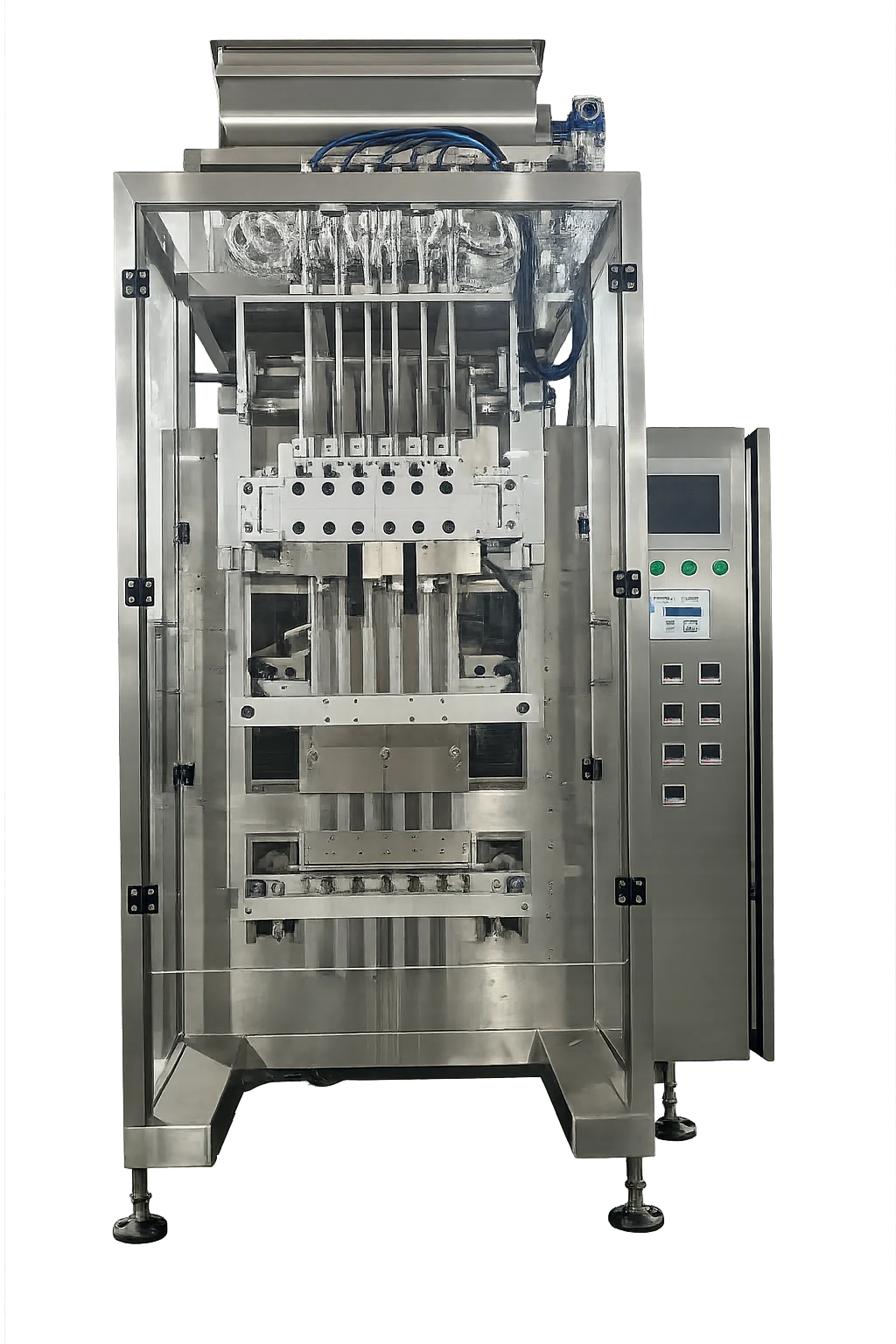
Start before the dosing device. Product can pass through a transfer container, feeder, hopper, metering components and discharge path before entering the film. Identify which surfaces contact the product, where material can remain and how each relevant component is accessed.
Ask for an equipment-specific contact-part list and a demonstration of removal and refitting where applicable. Review joints, seals, narrow passages and interfaces with upstream equipment. A clean outer frame does not show whether product remains in a hidden internal location.
Check access in the installed arrangement
The factory floor may provide more space than the intended packing room. Confirm how guards open, parts are removed and tools are handled after conveyors, feeders or neighboring equipment are installed. Include the cleaning operator's working area in the layout, not only the machine footprint.
Access is a recognized equipment-design consideration: IMA's STICK Series description discusses accessibility for cleaning and format changes on its equipment. That supports asking concrete access questions; it does not establish the cleanability of another manufacturer's configuration.
4. Agree the cleaning method before ordering
Dry removal, manual wet cleaning, cleaning removed components and an engineered clean-in-place arrangement are different methods. Ask which parts of the proposed equipment can use each method and what the manufacturer's instructions permit. Do not infer washdown suitability from stainless steel construction.
A powder application may need control of both residue and unwanted moisture. A liquid application can raise different questions about the supply vessel, hoses, pump and nozzle. Identify the relevant cleaning agents, temperatures, material compatibility and drying arrangements with the equipment and quality teams.
Distinguish cleaning access from cleaning effectiveness
A removable part may be easy to reach without being easy to clean for every formulation. Conversely, a closed liquid path should not be described as clean-in-place merely because liquid can be circulated through it. Review the designed method, coverage and verification requirements for the actual system.
Ask how cleaning tools, dismantled components and used cleaning materials are segregated. Specify where cleaned parts are inspected and stored before reassembly. These tasks can sit outside the machine's supply boundary, so allocate responsibility explicitly.
5. Establish inspection, verification and release responsibilities
The product owner should define the required evidence that the equipment is ready for the next product. Visual inspection, cleaning records and analytical checks have different purposes. A visually clean surface alone does not demonstrate every ingredient-control or microbiological requirement.
FDA's retail surface-cleaning research found that the residue, surface and wiping conditions influenced allergen removal and transfer. That study concerns its own retail test conditions, not validation of an industrial stick pack line. Its practical relevance here is to avoid assuming that any single wipe or visual check proves removal.
Keep equipment supply and process approval distinct
Agree who develops the cleaning procedure, who performs it, who reviews the evidence and who releases production. Discuss the information and access the manufacturer supplies to support those activities. A component material certificate or equipment quotation does not by itself approve the next product campaign.
6. Measure changeover from accepted output to accepted output
Define a common start and finish for timing. A useful operational measure starts with the last accepted pack from the previous campaign and ends when the next campaign meets its agreed release conditions. Record the intermediate tasks rather than reporting only the fastest mechanical step.
Include product recovery, line clearance, dismantling, cleaning, drying where relevant, inspection, reassembly, format setup, film loading, recipe confirmation and startup checks. Some tasks can overlap with proper staffing and controls; others must remain sequential. Record both elapsed time and labor involvement.
An illustrative timing example
Suppose a hypothetical change needs 20 minutes of mechanical work, 35 minutes of cleaning, 45 minutes of drying and 15 minutes of restart checks, with no overlap. The elapsed interval is 115 minutes, not 20. These invented planning values illustrate the calculation; they are not a COTECH changeover guarantee or a cleaning instruction.
When comparing suppliers, use the same transition, staffing, method and acceptance definition. Ask which work is performed off-line and whether an additional component set is assumed. Otherwise, two apparently similar time claims may describe different production tasks.
7. Evaluate contact-part sets, format parts and storage
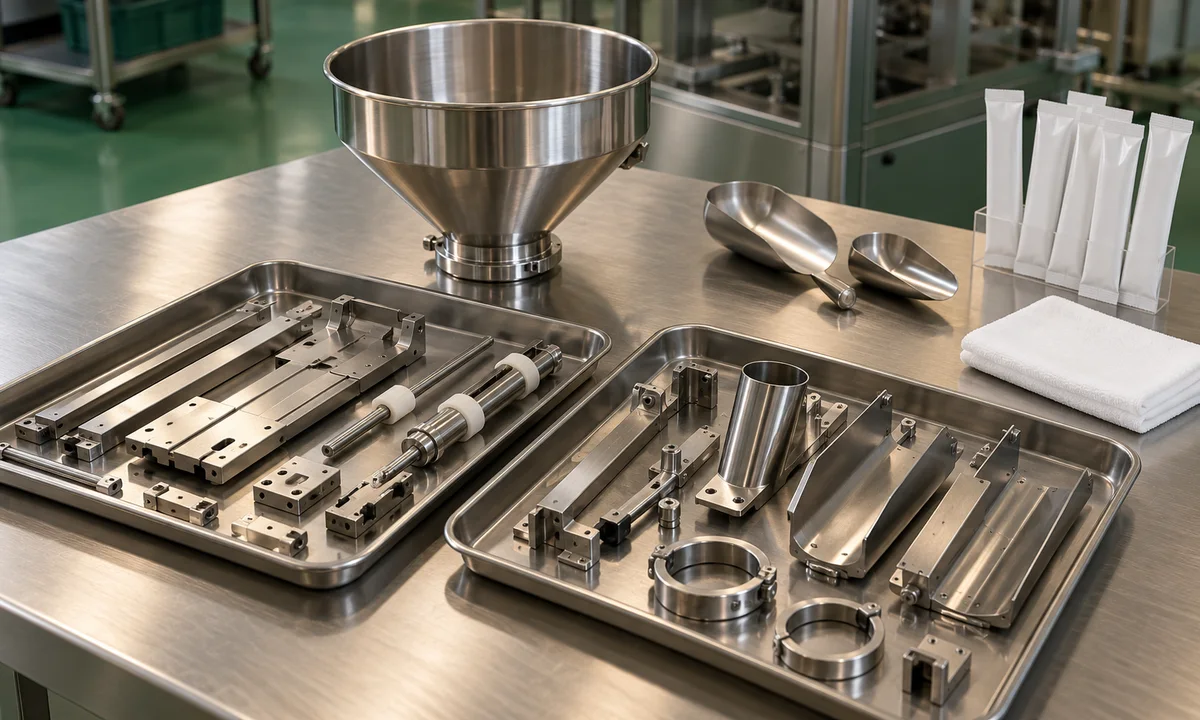
A spare contact-part set may allow some work to occur away from the machine, but it does not remove line clearance, inspection or release requirements. Review the complete set, identification method, storage conditions and the risk of assembling the wrong combination.
Distinguish product-contact components from format parts. A different stick width may involve different forming or sealing arrangements, while a new portion may require a dosing review. Confirm what is changed, what remains shared and which tools or skilled tasks are required.
Make reassembly repeatable
Request equipment-specific instructions, component identification and operator training. Discuss how correct installation is checked before restarting. Small seals, fasteners or spacers should not be left to memory. The purchasing decision should include the practical means to maintain the approved arrangement over repeated changes.
Consider the storage and movement of cleaned parts. A suitable machine can still be difficult to operate if parts are carried through an unsuitable route or placed on an uncontrolled surface while the next format is prepared.
8. Demonstrate the relevant transition during factory testing
Plan the trial around the product application and the decision you need to make. Identify the starting product, next product, film, formats, operator responsibilities and the tasks included. Agree how the demonstration will be recorded and where the quality team's separate approval activities begin.
Ask to observe access, dismantling where included, handling of removed parts, reassembly and startup sampling. Record any adjustments needed after the change. The first few acceptable sticks should not conceal a long period of repeated setup or unrecorded rejects.
Describe the evidence accurately
A supplier demonstration can show an agreed changeover sequence and practical access. It does not automatically validate allergen removal, establish product stability or approve every future formulation. State the tested conditions and the limitations alongside the results in the factory acceptance record.
Before shipment inspection, confirm the supplied component sets, drawings, instructions and agreed spare items against the packing list. The destination team needs the same information and parts used to support the demonstrated setup.
9. Connect changeover to the production schedule
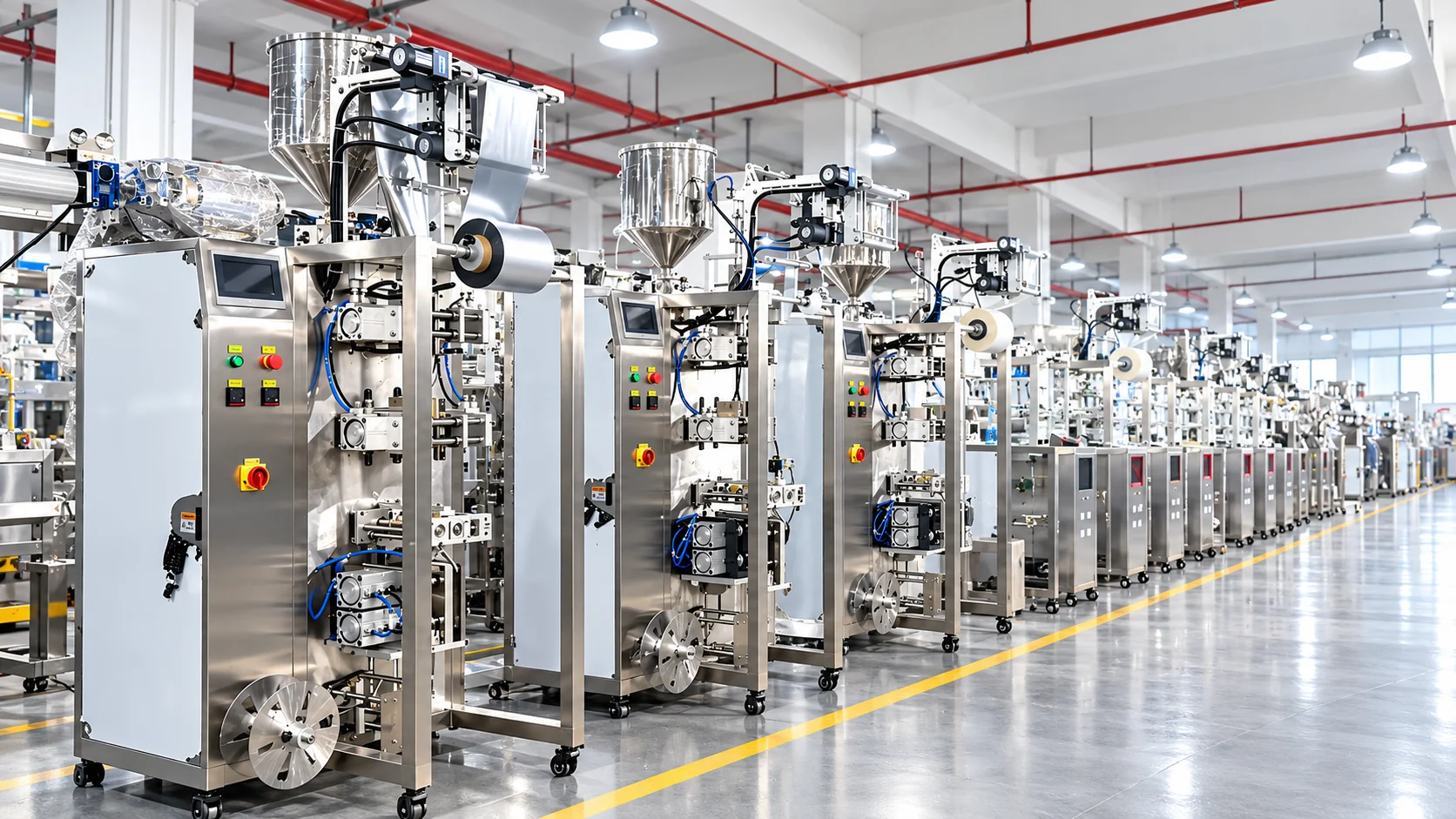
A high running rate can be less useful when campaigns are short and transitions consume much of the available shift. Compare accepted output over the planned schedule, including realistic changeovers and product release. Keep nominal machine speed separate from scheduled production availability.
Ask whether campaign sequencing, a dedicated contact-part set or separate equipment for demanding products deserves evaluation. These choices affect floor space, capital cost and quality controls as well as time. A changeover decision should involve production, maintenance, sanitation and quality personnel.
Prepare the destination site
Confirm the cleaning area, utilities, drying or storage arrangements and staffing before delivery. Include those requirements in installation preparation. A factory demonstration cannot compensate for missing space or an unavailable procedure at the customer's facility.
Retain changeover records after commissioning. Comparing the planned sequence with actual experience can reveal training needs, missing parts or opportunities to organize work more effectively. Avoid changing the approved cleaning method solely to achieve a shorter recorded time.
10. Put changeover requirements into the enquiry
Send the product matrix, desired formats and representative samples. State whether you need a discussion of manual cleaning, removable contact parts or another defined arrangement. Include the room layout, production sequence and the evidence your quality team expects.
- Which components contact each formulation, and which remain shared?
- What cleaning methods and access arrangements are permitted?
- Which format parts, tools and spare sets are included?
- How is changeover time defined and demonstrated?
- Who provides procedures, training, verification and production release?
Clear answers make quotations easier to compare. They also prevent an attractive phrase such as quick changeover from standing in for the specific transition your business needs to perform.
11. Compare quotations using the same transition brief
Give each supplier the same starting and finishing products, format drawings and cleaning expectations. Request a written explanation of the proposed contact-part scope and the tasks included in any changeover demonstration. This prevents an apparently faster offer from relying on an easier transition or an unpriced component set.
Separate included equipment from buyer-provided infrastructure. A quotation might include removable product-contact parts while assuming that the buyer provides washing, drying, inspection and storage facilities. Another might include additional handling equipment. Compare those boundaries before comparing the elapsed-time claim.
Use three practical purchasing questions
- Can the proposed design perform the required transition using the agreed method?
- Can the available people and site repeat the sequence without improvised parts handling?
- What evidence supports release of the next product, and who owns that decision?
Record unanswered questions as open items rather than treating silence as inclusion. Ask for drawings, instructions or an agreed trial where a statement cannot be assessed from the quotation. A supplier can explain the machine arrangement, while the product owner determines the process requirements the arrangement must support.
Finally, connect the decision to the expected campaign pattern. A business packing one stable formulation for long periods may prioritize differently from a contract packer changing products several times in a schedule. The better proposal is the one whose demonstrated scope fits the defined work, not necessarily the one advertising the shortest unspecified changeover.
FAQ
How long does a stick pack machine changeover take?
There is no useful universal time without a defined transition. Product removal, cleaning, drying, format work and release checks can all contribute. Ask for an equipment-specific demonstration using the agreed start and finish, products, staffing and acceptance criteria.
Can a stainless steel machine be washed down?
Not necessarily. The permitted method depends on the complete design, component protection and manufacturer's instructions, not just the visible frame material. Confirm which assemblies can be cleaned wet, which must be protected and whether removed parts need separate treatment.
Can the same machine pack different allergens?
That requires an application-specific review by the product owner's quality and food-safety teams. Evaluate the product sequence, shared surfaces, cleaning method and required verification. A machinery brochure or a general cleanability statement does not establish that a particular transition is acceptable.
Does clean-in-place eliminate dismantling?
Do not assume so. Define the actual circuit, components, method and inspection requirements for the supplied system. Some assemblies or transitions may require additional access or separate cleaning. A circulation connection alone does not demonstrate an effective clean-in-place process.
Are extra contact-part sets always worthwhile?
No. Their value depends on campaign frequency, off-line cleaning capability, storage and the components actually shared. Compare the complete workflow and cost. Extra parts can support planning, but they also require identification, inspection and controlled reassembly.
What should a buyer request during factory testing?
Request an agreed transition demonstration, a task-by-task record, relevant access and refitting instructions, and finished-pack checks after restart. Clearly separate the demonstrated machine sequence from the product owner's cleaning validation and release responsibilities.
Conclusion: buy a repeatable transition, not a vague time claim
A useful cleaning and changeover specification connects formulations, contact surfaces, methods, parts and accepted production. Define that transition early, demonstrate the relevant tasks and prepare the site to repeat them. This gives multi-product buyers a more realistic basis for comparing a stick pack machine and planning its daily use.
Define your next product change before choosing the machine
Send COTECH your product sequence, formulations, pack sizes and planned cleaning approach. Include contact-material requirements, the available cleaning area and the changeover evidence your team needs. Ask for a configuration discussion based on those customer requirements.
Send Your Requirements