
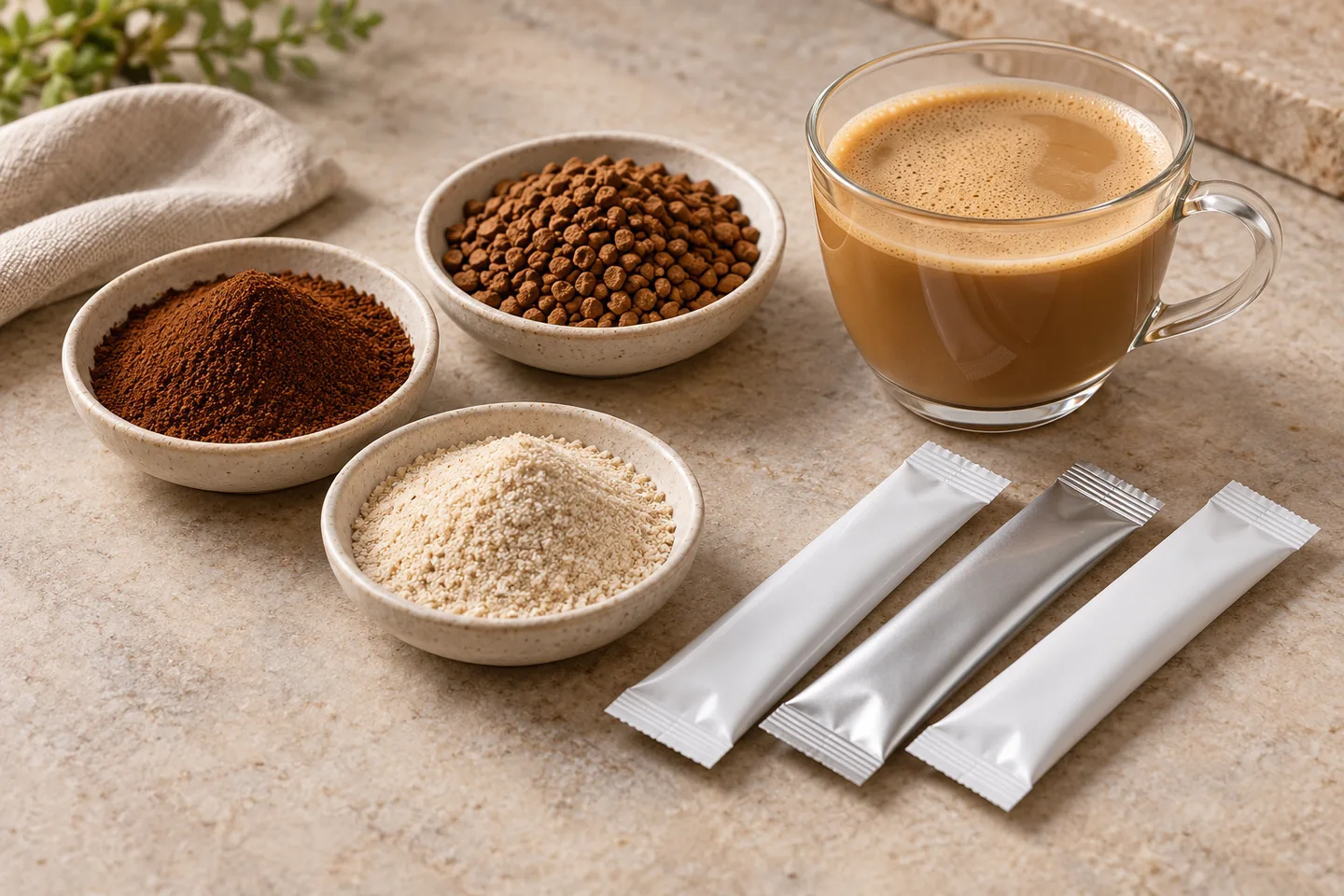
Introduction: what should an instant coffee stick pack machine handle?
An instant coffee stick pack machine should be specified for the actual soluble powder, granules or premixed recipe, its portion and the required finished pack. Evaluate product feeding, dosing, particle handling, seals and accepted output together. A machine demonstrated with one black-coffee portion does not automatically establish performance for a larger 3-in-1 blend.
For an overseas coffee brand, the buying decision connects the ingredient supply chain with packaging operations. A formulation may arrive as spray-dried powder, larger soluble granules or a mixture containing coffee, sugar and creamer. The same retail description can therefore cover materially different filling tasks.
COTECH's Coffee & Derivatives application page introduces its packaging routes. This guide focuses on the information coffee producers and contract packers should provide before selecting equipment. It uses explicit planning examples and does not present another manufacturer's performance or an imagined customer project as COTECH evidence.
1. Distinguish soluble coffee from ground coffee
Soluble coffee is designed to dissolve during preparation. Roast-and-ground coffee normally requires a brewing or extraction method, and a package for it may serve a different consumer task. Do not treat a photo of brown powder as enough information to select the filler or the finished package.
Instant coffee manufacturing can also produce different particle forms. DEK's processing overview describes spray-dried powder, agglomerated particles and freeze-dried granules. These distinctions help frame the product discussion; they do not establish a particular machine setting or a universal handling specification.
Ask the ingredient supplier for relevant properties
Provide the product form, particle-size information, measured bulk density, fines, moisture-related handling limits and any restrictions on mechanical treatment. Explain how the product is transported and presented to the packaging machine. A sample taken before a long transfer may not represent the material that actually reaches the dosing hopper.
2. Define 2-in-1 and 3-in-1 by their actual recipes
Commercial recipe names are not complete technical specifications. Write down which ingredients are present and in what relevant physical form. A 2-in-1 label should not be interpreted automatically as one particular coffee-and-sugar or coffee-and-creamer combination across every market.
For a 3-in-1 product, the complete coffee, sweetener and creamer blend reaches the filler. Particle size, fat-containing ingredients, flavor carriers and density differences can influence flow and the behavior of the mixture. Ask the product owner which properties and changes matter to the finished drink.
Separate blending from portioning
Clarify whether the machine receives an already prepared blend or whether upstream mixing is part of the wider project. A single dosing unit does not independently establish ingredient ratios in every portion. Blend uniformity and segregation need their own product-quality assessment, even when the total stick weight looks consistent.
Include every planned recipe in a matrix and identify which ones need separate trials. Black coffee, a sweetened premix and a milk-containing formulation should not be grouped into one undefined coffee product solely to simplify a quotation.
3. Match the portion to usable pack volume
Record the complete serving weight and estimate its occupied volume using the actual bulk-density method. Compare those requirements with the formed pack, including the available space for discharge and clean sealing. A larger premix portion can require different dimensions or format parts from a small soluble-coffee serving.
| Product description | Material questions | Pack questions |
|---|---|---|
| Fine soluble coffee | Density, fines, dust and moisture sensitivity | Portion volume and clean seal area |
| Soluble granules | Size, flow and sensitivity to particle damage | Discharge clearance and opening |
| 2-in-1 or 3-in-1 mix | Complete recipe, segregation and buildup | Full serving volume and dispensing |
| Flavored coffee range | Recipe differences and changeover controls | Format range and artwork identification |
For an illustration, a hypothetical 2 g portion and a 20 g premix differ tenfold in mass before density differences are considered. That does not imply a tenfold change in machine output or define a standard serving. It shows why the proposed product and pack must accompany every capacity claim.
4. Evaluate the dosing route using product samples
Fine or less free-flowing powders may lead to an auger-based discussion, while suitable free-flowing granules may be assessed with a different volumetric arrangement. The product and required portion determine the useful approach. Do not assume every coffee material needs the same device because the machine produces the same pack shape.
Discuss hopper presentation, replenishment, discharge and any buildup on contact surfaces. Observe how the proposed arrangement behaves as the hopper level changes or after an agreed stop. Record net portion measurements by lane and time instead of using one combined average to describe all filling positions.
Keep product condition visible during the test
If granules become finer through handling, the filling behavior and consumer appearance can change. Retain samples before and after the relevant transfer and filling steps where appropriate. Agree what particle condition matters to the product owner, rather than declaring the process gentle from a machine photograph alone.
5. Review transfer, dust and replenishment
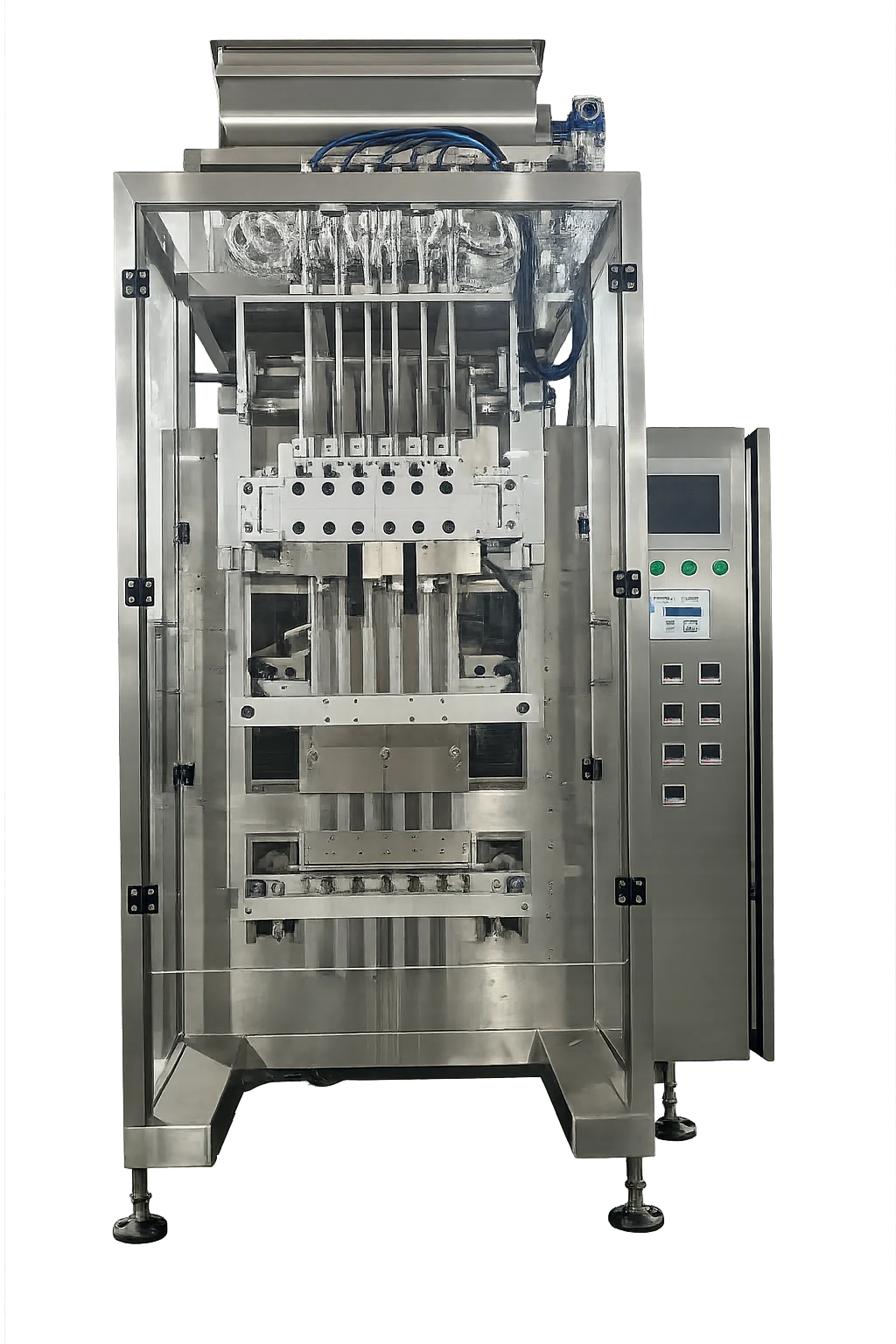
The packaging result begins upstream of the forming section. Identify how bulk coffee or premix reaches the machine, how it is replenished and how long an opened batch remains exposed. Transfer equipment and handling practices can affect the presentation of material to the dosing system.
Powder dust near seals can affect pack integrity, while unnecessary mechanical treatment can alter sensitive granules. Define the relevant product requirements and the boundaries of any feeder, extraction or transfer equipment in the quotation. A main machine price does not automatically include a complete upstream handling solution.
Observe the complete production interval
Factory testing should include relevant operating stages rather than only a brief period with a freshly loaded hopper. Agree the replenishment method and observe stops, product accumulation and interventions. These records help the team understand whether the demonstrated condition is practical for the customer's normal production schedule.
6. Connect aroma protection with film and seal integrity
Define the product owner's requirements for moisture, oxygen, light and aroma retention with the film supplier. The complete laminate and finished-pack construction matter; an attractive metallic surface alone does not identify the barrier structure or the performance of the sealed package.
Provide film thickness, construction, roll geometry, unwind direction and registration data. Check the actual coffee or premix at the seals during trials. A film that makes acceptable empty sticks may behave differently when dust, a larger portion or product buildup enters the process.
Evaluate gas flushing as a specified option
If nitrogen flushing is proposed, agree its purpose, equipment scope, gas supply and verification method. Do not infer that it is standard on every machine or that its presence guarantees a particular shelf life. Suitable barrier material, effective seals and product-specific stability evidence remain separate requirements.
The film selection guide can help structure that conversation. Keep any claimed storage performance tied to the evaluated product, package and conditions rather than copying a shelf-life figure from a different coffee product.
7. Check preparation, opening and artwork
The portion should fit the intended cup or preparation method, and the package should open and dispense accordingly. Evaluate how easily the complete serving pours out, whether powder remains trapped in corners and whether the opening is practical for the user's vessel. These observations belong alongside filling and seal checks.
Assess print registration, coding and the relationship between artwork, seals and cuts. A long artwork panel or opening feature can impose format requirements beyond the portion volume. Share the pack drawing with both the converter and equipment supplier before ordering a commercial quantity of printed film.
Keep SKU identification controlled
Similar-looking rolls can carry different recipes, languages or serving instructions. Include line clearance and material identification in the product owner's procedures. Machine setup and coding checks support those procedures, but the complete prevention of a labeling mix-up should not be inferred from a registration sensor alone.
8. Plan the recipe sequence and cleaning access
Define which changes involve only artwork, which alter the dose or format, and which introduce a new formulation. A switch from black coffee to a creamer-containing product can raise different cleaning and product-control questions from changing the length of an otherwise identical stick.
Trace the product-contact path through transfer equipment, hopper, metering components and discharge areas. Discuss access and permitted cleaning methods using the actual proposed assembly. Product owners should establish the necessary cleaning verification and release requirements for the recipes and ingredients involved.
Include restart verification
Measure a changeover to the first accepted pack of the next product, not simply the end of a mechanical adjustment. Check the new material, code, portion, seals and opening. The existing changeover guide explains how to distinguish tasks that are often hidden inside one optimistic time estimate.
9. Calculate demand in accepted sticks and sales units
Record the number of sticks per retail carton or outer bag and the required sales units per shift. Explain available operating time, replenishment and expected product changes. Counting, collection and secondary packing can determine whether a primary machine's demonstrated running rate is useful at the site.
For a hypothetical plan of 2,400 cartons containing 10 sticks each, the requirement is 24,000 accepted sticks. Over 300 allocated production minutes, that is 80 accepted sticks per minute. These numbers describe an invented demand scenario, not the capacity of a COTECH model.
Agree the scope beyond the filler
Compare a standalone machine and an integrated stick pack line only after defining the downstream task. Ask who supplies transfer interfaces, counting and secondary handling, and which functions are demonstrated together. A photograph of a long line is not an itemized scope of supply.

A two-recipe review: avoid one undefined coffee specification
Consider an illustrative buyer planning a small black-coffee portion and a much larger flavored premix. The buyer initially requests one coffee machine and a single output figure. That brief leaves important questions unresolved: the products have different serving volumes, material behavior and potentially different format requirements.
Build two application records instead. For black coffee, identify powder or granule form, the portion, particle requirements and product-protection needs. For the premix, identify the complete recipe, density, flow, portion and relevant cleaning controls. Attach each proposed pack drawing and film specification so the equipment supplier can review the same information as the converter.
Ask which changes occur between the recipes
The proposal should explain whether the transition changes settings only, requires format or dosing components, or remains subject to further testing. Identify product clearance, cleaning and restart checks separately. If the second recipe was not demonstrated, mark its performance as unresolved rather than borrowing a speed or portion result from the first.
Also compare the sales-unit requirement for each recipe. Different stick counts per carton can change counting and secondary-packing demand even when primary output is similar. A useful configuration discussion therefore preserves the link between each recipe, its finished pack and its commercial presentation.
This example is a method for organizing customer requirements, not a report of a COTECH installation. It helps the buyer see whether one proposed system has a defined route for both products or whether different equipment and additional trials deserve consideration before ordering.
10. Turn the coffee brief into a trial and handover record
Identify recipe and product lots, film, portion, pack drawing and the proposed running condition before factory testing. Agree net-content sampling, particle observations, seal checks, coding, opening and accepted output. Retain the settings and interventions associated with both satisfactory and unsatisfactory samples.
Shipment inspection should reconcile the purchased configuration, supplied formats, agreed spares and documents. Installation preparation should cover product and gas supply where relevant, utilities, room conditions, measuring equipment and operator access. Bring enough representative product and approved film for the agreed startup evaluation.
Preserve the basis of the demonstration
Record any change between factory and site, including ingredient source, recipe, film construction or transfer arrangement. Decide whether the change requires additional assessment. A coffee trial is most useful when the customer can identify the conditions that produced its results, rather than receiving only a video with no supporting context.
Frequently asked questions
Can one machine pack black coffee and 3-in-1 mixes?
Possibly, after reviewing the formulations, portions, formats and required changes. The dosing and contact-part arrangement may differ. Ask the supplier to identify the purchased product range and what each change requires rather than accepting a general claim that every coffee recipe runs identically.
Is freeze-dried coffee the same packaging task as fine instant powder?
No. Particle size, fines, density and handling sensitivity can differ. Evaluate the material that will actually enter the hopper, including the transfer route. Confirm fill consistency and the product owner's particle-condition requirements through an appropriate trial.
Does a 2-in-1 label identify the ingredients?
Not reliably across every market. Provide the actual recipe and physical properties. Coffee, sweeteners, creamers and flavor carriers can change portion volume, flow and cleaning requirements. The equipment specification should follow the formulation rather than an assumed interpretation of a retail name.
Is nitrogen flushing required for every coffee stick?
Do not treat it as universal. The product and packaging teams should define the protection requirement and assess any proposed gas-flushing arrangement. Confirm gas supply, measurement and scope explicitly. Neither nitrogen alone nor a generic laminate description establishes finished-product shelf life.
What determines a coffee stick pack machine's output?
The active configuration, recipe, portion, film, sealing conditions, supply and downstream process all matter. Compare accepted sticks over a defined period, with rejects and interruptions recorded. A rate demonstrated using another portion or material does not establish your own application's performance.
What information should we send with a coffee enquiry?
Provide the material form and recipes, samples, portion range, density, pack drawing, film and shift target. Add sales-unit counts, changeovers and installation conditions. COTECH can then discuss whether a stick pack machine or another packaging route deserves evaluation.
Conclusion: specify the coffee product before the machine
A useful instant coffee packaging proposal distinguishes fine powder, soluble granules and complete premixes. Define the serving, product handling, film, opening and sales-unit demand, then use representative trials to evaluate the proposed equipment. Keep performance statements connected to their actual conditions.
That approach helps coffee brands, converters and COTECH work from one practical application brief. It also makes later recipe or format changes easier to assess because the team can see what was tested, supplied and prepared for installation.
Prepare an equipment review for your coffee recipes
Send COTECH your instant coffee or premix samples, target portions, pack drawing, film specification and accepted output requirement. Include the sales-unit count and any gas-flushing or product-handling requirements so the team can discuss the proposed configuration and trial scope.
Get a Quote