
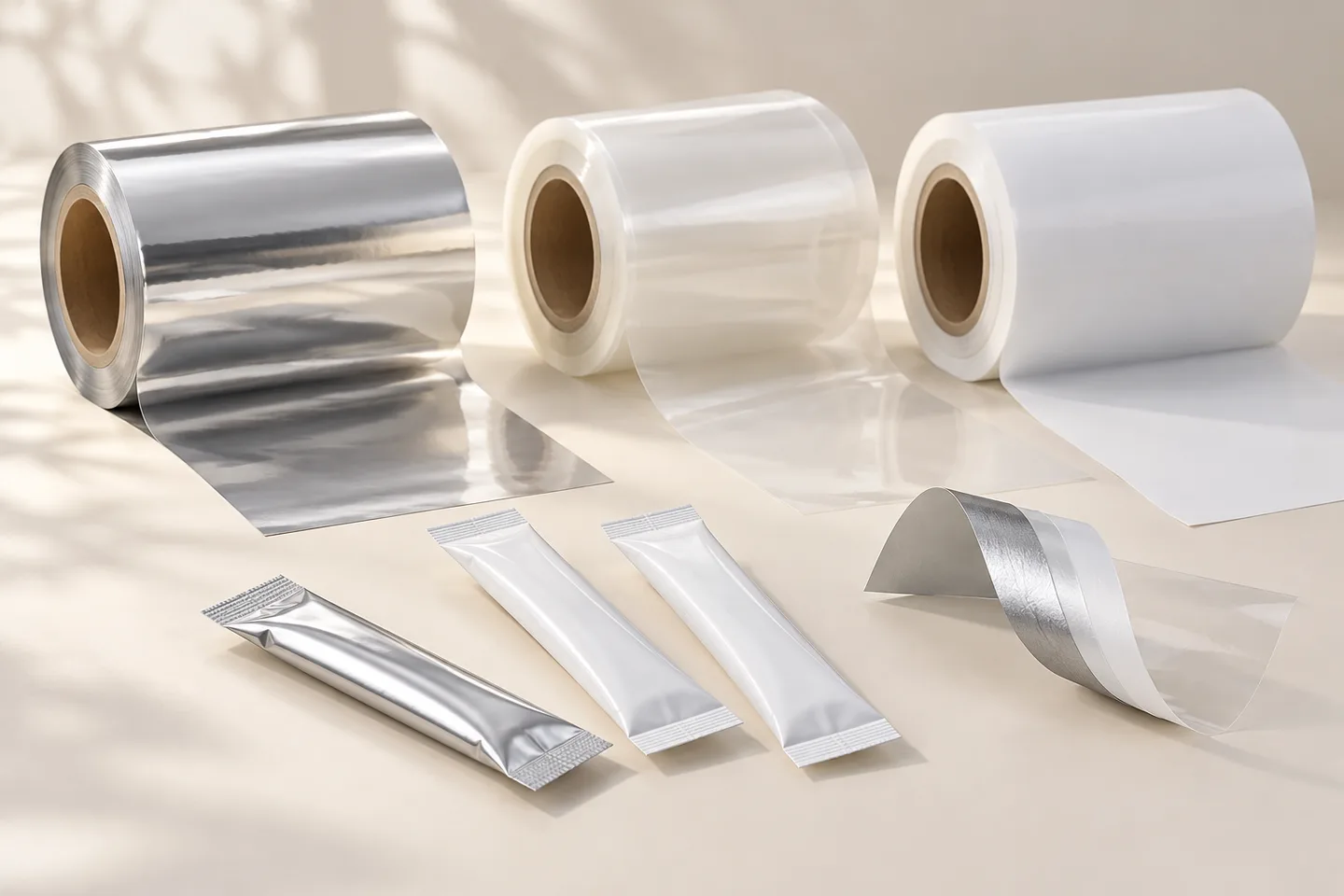
Introduction: which film is right for a stick pack machine?
Choose stick pack packaging film by matching product protection, seal performance, consumer opening and roll specifications to the intended machine configuration. Compare barrier data under stated test conditions, then run the actual product and film together. A familiar laminate name or a high barrier number alone does not prove that the finished stick will seal and perform correctly.
Film selection connects several teams: the brand defines the product and customer experience, the converter supplies the material, and the equipment manufacturer evaluates how it runs. When those discussions happen separately, an attractive printed roll can arrive before its forming, sealing or opening behavior has been checked.
This guide gives overseas food and supplement buyers a practical specification and trial framework. It applies to projects using COTECH stick pack equipment without implying that every film structure can run on every model. Application evidence establishes the usable combination of product, film, format and operating conditions.
1. Define what the finished package must do
Begin with the formulation and the distribution route. A moisture-sensitive electrolyte mix, an aromatic coffee powder and a viscous gel can need different protection. List the changes that would make the product unacceptable, such as caking, flavor loss, oxidation or interaction with the package. The product owner should establish the relevant stability requirements.
Then describe the consumer task. A stick intended to pour into a water bottle has a different opening requirement from a gel consumed directly from the pack. Include portion size, desired opening, appearance and the amount of product that can reasonably remain inside after use.
Specify the storage and sales unit
Explain whether sticks are sold individually, placed in cartons or grouped inside another pouch. Identify the conditions each packaging layer is expected to withstand. Secondary packaging may help with physical handling or display, but its presence does not automatically establish the barrier performance of an individual stick.
2. Understand the role of each film layer
A flexible laminate can combine an outer surface for printing and mechanical handling, a barrier component and an inner sealant that contacts the product. Some layers can perform more than one function. Ask the converter for the actual structure, total thickness and relevant specifications rather than ordering by an informal material nickname.
Structures containing polyester, aluminum foil and polyethylene may be considered for particular applications, while other projects assess metallized or polyolefin-based alternatives. These are material families, not interchangeable recipes. Thickness, coatings, adhesives and sealant formulation can change the behavior of two films carrying similar descriptions.
Confirm the product-contact surface
Identify which side faces the product and how the proposed longitudinal seal is made. A fin seal joins inside surfaces, while a lap-seal arrangement can require a compatible outside surface. Confirm the machine's actual seal geometry with the equipment supplier; do not assume that a film prepared for one arrangement suits another.
3. Compare barrier values with their test conditions
Water vapor transmission rate, usually abbreviated WVTR, describes moisture transfer through a material under specified conditions. Oxygen transmission rate, or OTR, describes oxygen transfer. The values answer different questions and should be recorded with their units, temperature, humidity and test method. Numbers measured under different conditions are not a like-for-like comparison.
ASTM F1249 describes a method for determining water vapor transmission through flexible barrier materials. Its public scope helps explain what a film measurement represents. It does not establish the shelf life of a particular supplement, coffee or drink mix.
Move from flat film to finished packs
Ask how the complete package will be evaluated after forming and sealing. Seams, folds, defects and handling can affect performance that is not represented by a flat-film datasheet. Establish shelf-life evidence with the product owner and film supplier, using the intended formulation and storage conditions rather than converting a single barrier value directly into months of shelf life.
4. Review the sealing window and seal quality
Heat sealing depends on the material and the combination of temperature, contact time and pressure at the seal. Controller settings do not necessarily equal the temperature experienced across every point on the film. Jaw condition, alignment and product in the seal area can also affect the result.
A useful sealing window is the set of operating conditions that produces the required seal without unacceptable distortion or damage. Discuss how the trial will explore that window instead of requesting one universal temperature. Low-temperature seal initiation, hot tack and cooled seal strength describe related but different aspects of sealing.
Distinguish strength from integrity
ASTM F88/F88M concerns seal strength in flexible barrier materials. A strength result is not, by itself, a complete leak assessment. Agree the relevant integrity checks, sample conditioning and acceptance criteria with the packaging team; a seal can appear strong while a localized channel remains elsewhere.
As a materials example, Dow's sealant information discusses hot tack and seal initiation as separate performance properties. That distinction is useful when asking a converter for data, but a resin description does not demonstrate a finished laminate on your stick pack machine.
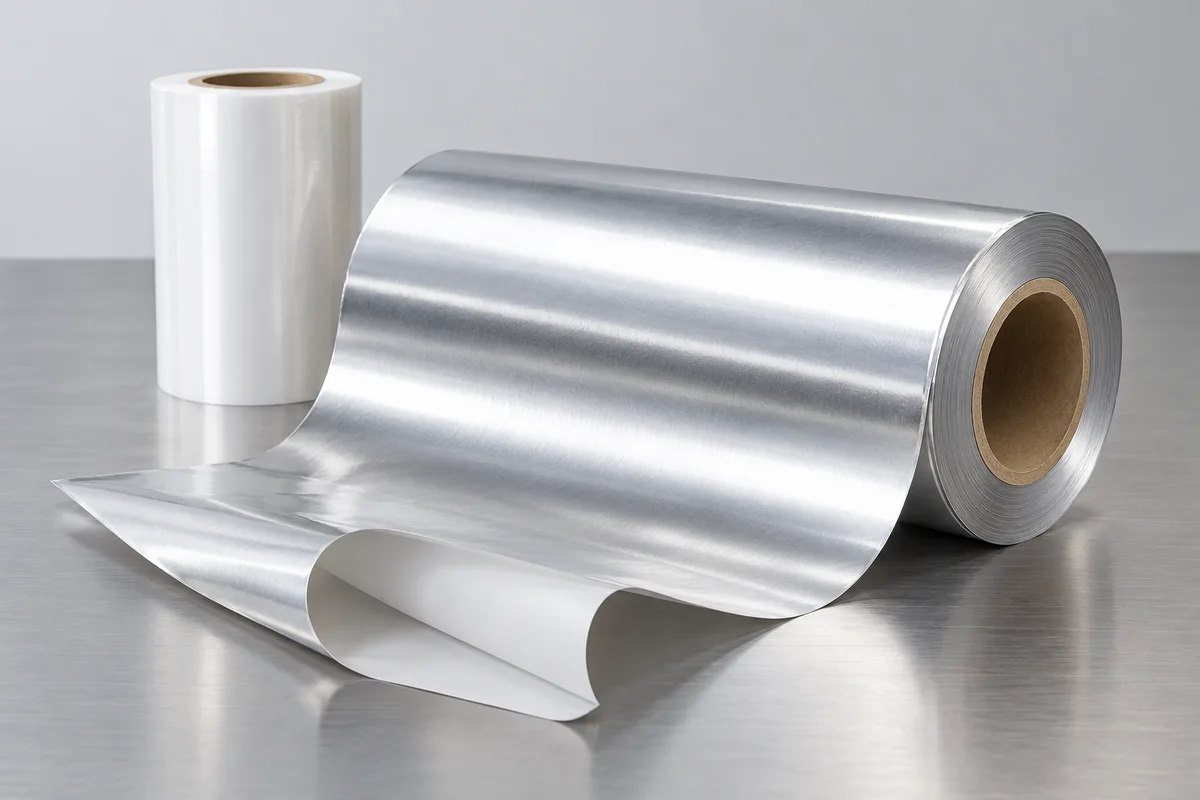
5. Give the converter a complete roll specification
The machine needs more than a material structure. Web width, core dimensions, maximum roll diameter and unwind direction determine whether the roll can be handled as intended. Print repeat, eye-mark position and artwork orientation should correspond to the forming and cutting arrangement agreed for the purchased format.
| Specification group | Information to provide | Trial question |
|---|---|---|
| Material | Structure, thickness, sealant side and relevant barrier data | Does the laminate meet the application requirements? |
| Roll geometry | Web width, core, diameter and unwind diagram | Can it load, track and feed correctly? |
| Printing | Repeat length, registration mark and artwork direction | Do print and cut positions remain aligned? |
| Finished pack | Dimensions, seal geometry and opening design | Does the portion fit and dispense as intended? |
For multi-lane equipment, confirm how lane positions correspond to the printed web and cutting arrangement. Get a shared drawing approved by the brand, converter and equipment supplier before a large film order. Small artwork assumptions can become expensive when repeated across a commercial roll.
6. Test product behavior at the film and seal
Powder dust, granules or liquid at a seal can create problems that an empty-film trial misses. Review dosing timing, discharge and the available distance between the product and seal area. Film marketed for improved sealing through contamination does not remove the need to manage the product path.
For nutraceutical powders, consider how humidity and dust affect operation during the planned run. For liquid stick packaging, assess drips, strings, splashing and whether product reaches the seal before it closes. Evaluate the actual formulation rather than water or a convenient substitute unless the substitution has a defined purpose.
Review film movement and appearance
Observe tracking, slip, static, wrinkles and pack flatness through the trial. A film can provide suitable protection yet be difficult to form or transport consistently under the proposed settings. Record the conditions and symptoms so the converter and equipment team can investigate the same evidence.
7. Evaluate opening and dispensing after sealing
A secure package must still be usable. Check the tear feature, direction of opening and whether the opening suits pouring or squeezing. Inspect a representative range of finished packs rather than one carefully selected sample. Opening performance should be assessed alongside seal integrity, not traded against it without understanding the consequences.
Include the actual user context. A powder stick may be opened over a narrow bottle neck, while a gel portion may be handled with damp hands. The product team can define appropriate usability checks without assuming that a competitor's pack dimensions will reproduce the same experience with a different laminate.
Keep artwork and coding legible
Confirm that seals, cuts and coding do not obscure essential information. Check mark registration after startup, restart and roll changes where relevant to the agreed test. Assess what happens to the printed appearance after forming, rather than approving only an unformed artwork proof.
8. Assess alternative films without unsupported claims
A request for a mono-material, reduced-thickness or different barrier structure is a new technical question. Ask the converter how the complete pack is designed, then test protection, forming, seals and consumer opening together. A material substitution can change the required settings and usable operating window.
CEFLEX's circular-design guidelines consider collection, sorting and recycling when evaluating flexible packaging design. Their framework is a useful reference for discussions with the material supplier. It should not be converted into a blanket statement that every pack made from a named polymer is recyclable in every destination.
Keep the destination market explicit
Discuss the complete structure, local collection systems and the basis of any environmental statement with qualified packaging partners. The machine manufacturer's compatibility trial demonstrates how the film runs under defined conditions; it does not certify the disposal route or establish a product's shelf life.
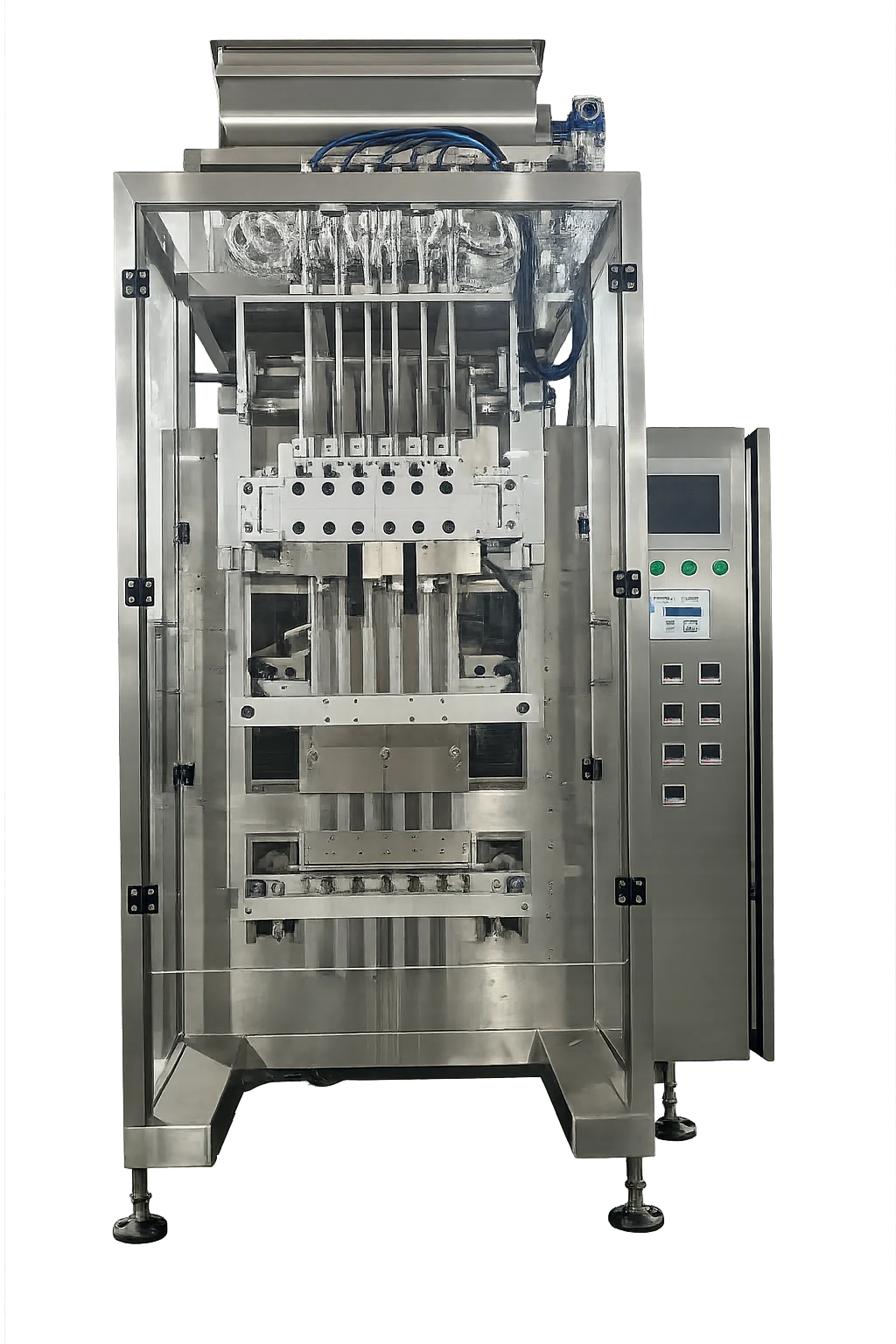
9. Create a product-and-film trial plan
Before factory testing, identify the film supplier, structure, roll lot, product lot, dose and pack drawing. Agree which settings and observations will be recorded. Use enough material to evaluate meaningful operation, including relevant startup or restart conditions, rather than judging the entire application from a few empty packs.
- Confirm roll loading, unwind direction and registration.
- Inspect forming, longitudinal seams and end seals.
- Measure fill and finished dimensions using agreed methods.
- Evaluate seal strength and integrity with appropriate checks.
- Review coding, opening and product dispensing.
- Record accepted output, rejects and interventions.
Keep failed samples and note where each defect occurred. Adjust one relevant variable at a time where practical and record the reason. This gives the team a traceable comparison rather than a successful video with no explanation of the conditions behind it.
A practical example: two barrier numbers that cannot be ranked
Suppose film A lists WVTR as 0.10 g/m²/day and film B lists 0.20 g/m²/day. Without the temperature, humidity, method and sample construction, the lower number does not establish which film is more suitable. If the measurements were made under different conditions, request comparable data before using the values to choose a structure.
Next ask which product change the barrier requirement is intended to control. Moisture pickup can affect a powder differently from oxygen exposure, and a quoted WVTR says nothing by itself about flavor retention or product-contact compatibility. Identify the required evidence for each concern and keep missing information visible in the film comparison.
Use observed defects to focus the next trial
| Observation | Questions to investigate |
|---|---|
| Wrinkled seal area | Is the web aligned, formed and transported consistently? Does the roll specification match the approved drawing? |
| Product trapped at the seal | How do dosing, cut-off and discharge timing affect the available clean sealing area? |
| Distorted pack at higher settings | Does the material tolerate the proposed temperature and contact time without unacceptable change? |
| Difficult opening | Does the tear feature work in the actual laminate and after the intended storage period? |
These questions are investigation prompts, not diagnoses from a photograph. Retain the samples and the associated settings so that the converter and equipment team can distinguish material, handling and product effects. A controlled comparison is more informative than increasing heat repeatedly until one sample looks acceptable.
10. Preserve the specification through shipment and startup
Keep approved drawings, film identification and trial settings with the project records. Shipment inspection can confirm the supplied format components and documents, while installation preparation should cover roll storage, handling, utilities and operator access. Avoid substituting a new film lot or structure during startup without recording the change.
When ordering repeat film, manage converter revisions, thickness tolerances, artwork changes and sealant substitutions through a defined review. Even a visually similar roll can behave differently if its construction changes. A useful handover package allows the customer, converter and machine supplier to trace which material was actually evaluated.
Frequently asked questions
What material is used for stick pack packaging?
Stick packs can use different heat-sealable flexible structures, including multilayer laminates and selected polymer-based alternatives. The correct choice depends on formulation, barrier, seal geometry, opening and equipment compatibility. Request the complete structure and supporting data rather than choosing only by a familiar abbreviation.
Does a higher barrier always make a better film?
No. Protection must suit the product, but forming, sealability, opening and handling must also work. Compare barrier values under the same conditions and evaluate the finished pack. Additional barrier alone cannot compensate for an unsuitable seal or product contamination.
What sealing temperature should we use?
There is no universal value. Material, thickness, jaw arrangement, contact time and pressure all matter. Agree a trial window with the film and machine suppliers, record the conditions and verify seal quality. A controller setting from another application is only a reference.
Can a stick pack machine run recyclable film?
A specific alternative film may be suitable after technical review and trials. Confirm its construction, forming, seal performance and barrier needs. Recyclability also depends on the complete package and destination systems; machinability is a separate question from an environmental claim.
Is seal strength testing enough to detect leaks?
No. Seal strength and package integrity describe different properties. Agree appropriate checks for the finished pack and record sample preparation and conditions. A satisfactory strength result on one strip does not establish that every seam and location is free from leakage paths.
What should we send before a film trial?
Provide the product specification, target portion, stick drawing, film structure and barrier data. Include roll dimensions, unwind and print-registration information plus a sample roll when available. Explain shelf-life and opening requirements so the test addresses the intended application.
Conclusion: qualify the product, film and machine as a combination
Good stick pack film selection connects protection, sealing, converting details and consumer use. Write the requirements first, compare meaningful data and evaluate the actual product on the proposed equipment. Keep the tested material and operating conditions identifiable from the first trial through installation.
That shared specification helps the brand, converter and COTECH make decisions from the same evidence. It also makes future changes easier to assess, because the team can identify which property or operating condition has changed instead of treating every printed roll as equivalent.
Review your film and stick pack machine together
Send COTECH your formulation, portion size, proposed stick drawing and film datasheet. Include a sample roll where available. Ask for a compatibility review and a product-specific trial covering feeding, sealing, opening and accepted output.
Send Your Requirements