
Introduction: how accurate should a stick pack filler be?
Stick pack filling accuracy should be evaluated against a defined product, target portion, measurement method and acceptance criterion. Measure net contents, assess each lane separately and repeat sampling under relevant operating conditions. A generic plus-or-minus claim, an attractive average or a video of a few packs cannot establish performance across a production run.
This guide is for food, supplement and contract-packing teams comparing stick pack machines or preparing a product trial. It explains how to separate a dosing problem from a weighing problem, how to interpret lane results and which conditions should be included in factory testing.
COTECH reviews powder, granule and liquid applications individually. Its stick pack equipment category introduces the different material routes. The purpose here is to help buyers write a testable requirement, not to assign one universal accuracy figure to every formulation and machine configuration.
1. Define target, bias and variation clearly
The target is the intended operating portion. A sample mean describes the center of the measured results, while variation describes their spread. The mean's difference from the operating target is a useful process indicator, but it should not be confused with the bias of the measuring instrument itself.
NIST's discussion of bias and accuracy distinguishes systematic measurement effects from general claims of accuracy. Apply that discipline when writing a machine requirement: state what is measured, against which reference and under which conditions, rather than treating accuracy as a complete numerical specification.
An average can hide unacceptable individual packs
If one lane fills above target and another below, combining them can produce an apparently satisfactory overall mean. Individual packs and lane behavior still matter. Keep the original measurements, lane identity and sampling time so that pooling does not hide the very problem the trial is intended to reveal.
2. Agree the filling requirement before collecting samples
Specify the nominal product quantity, the intended operating target and the engineering acceptance criteria for the trial. Identify whether a stated percentage refers to nominal fill, full-scale capacity or another quantity. A percentage without its denominator and test conditions is not a usable purchasing requirement.
For an arithmetic example, 1% of a 5 g target is 0.05 g, while 1% of a 20 g target is 0.20 g. This explains why absolute mass and percentage statements can imply different expectations. These numbers are not COTECH specifications or legal limits for prepacked products.
Keep different approvals separate
Your quality team should determine the applicable product and market requirements. Equipment acceptance, net-quantity compliance and ingredient-content uniformity are separate questions. A machine trial can support a defined filling assessment; it cannot, by itself, establish the legal status, composition or overall quality of every future production batch.
3. Check the measurement process first
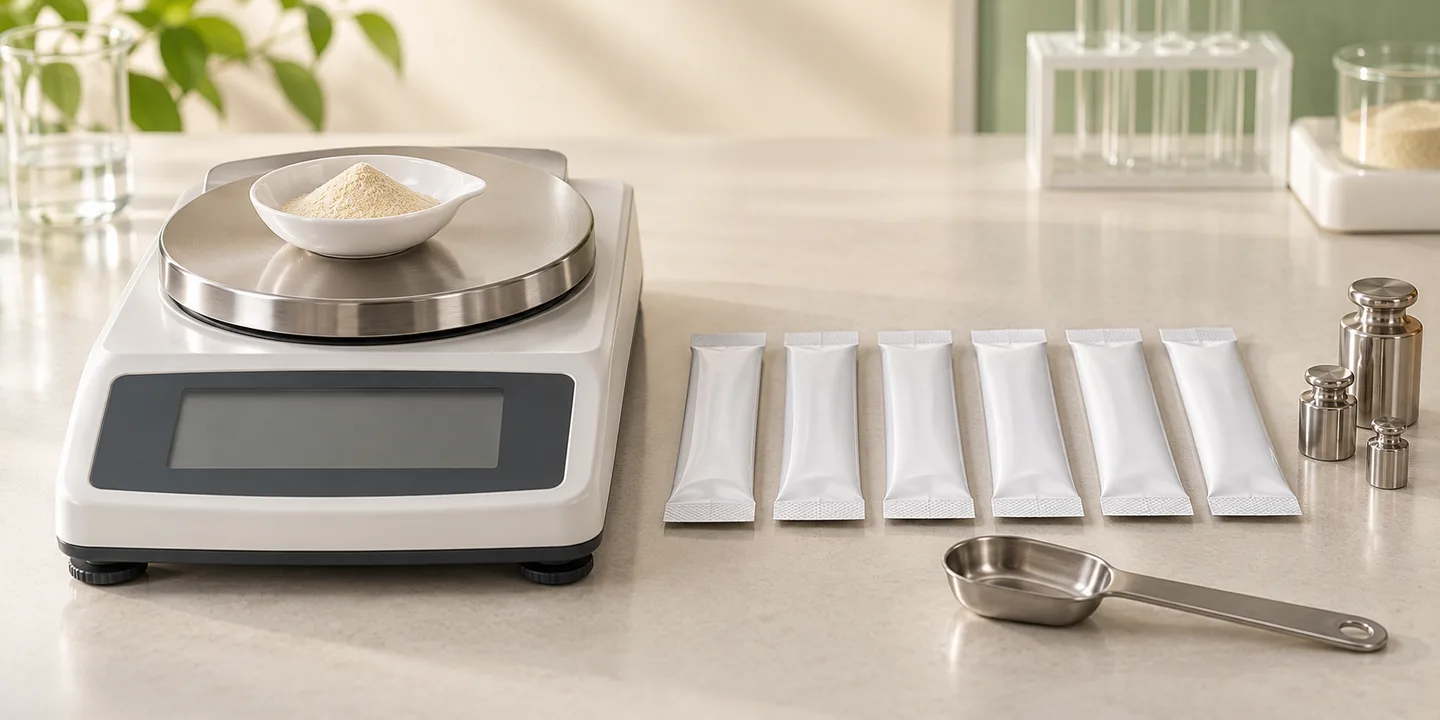
Choose a balance or weighing method suitable for the portion and the decision being made. Consider readability, capacity, repeatability, calibration status and the environment. A display with many decimal places does not automatically establish a reliable net-weight result, especially if vibration, airflow or unstable handling affects the reading.
Confirm the reference checks and operating procedure before testing the filler. Use a consistent method for placing samples, allowing readings to settle and recording results. Identify the instrument and operator in the record. If different people or instruments give materially different results, investigate the measurement method before adjusting the machine.
Understand short-term and longer-term variation
NIST's guidance on measurement variability explains why short-term repeatability and longer-term changes are distinct. For the packaging trial, that means a stable instrument check at the start is useful but does not eliminate the need to watch conditions and verify the measurement process over time.
4. Measure net contents and control the tare method
The filled pack's gross mass includes product and packaging. Net contents require a justified way to remove packaging mass, or tare, from that measurement. Film area, thickness, seal dimensions and cutting variation can affect the wrapper's contribution. Confirm whether the chosen tare method is sufficiently representative for the trial.
One evaluation approach weighs an individual empty wrapper associated with its filled pack, subject to a defined emptying and cleaning method. Another uses a representative packaging tare determined through an agreed procedure. Each approach has practical limitations. Product left inside a wrapper or inconsistent sample preparation can distort the calculated net result.
Do not silently change the method mid-test
Record the tare procedure, sample preparation and any corrections. If the packaging material changes, review whether the established tare still applies. For liquids or sticky gels, discuss how product removal and any volume-to-mass conversion will be handled without introducing uncontrolled assumptions about density or residual material.
5. Keep lane and time information with every sample
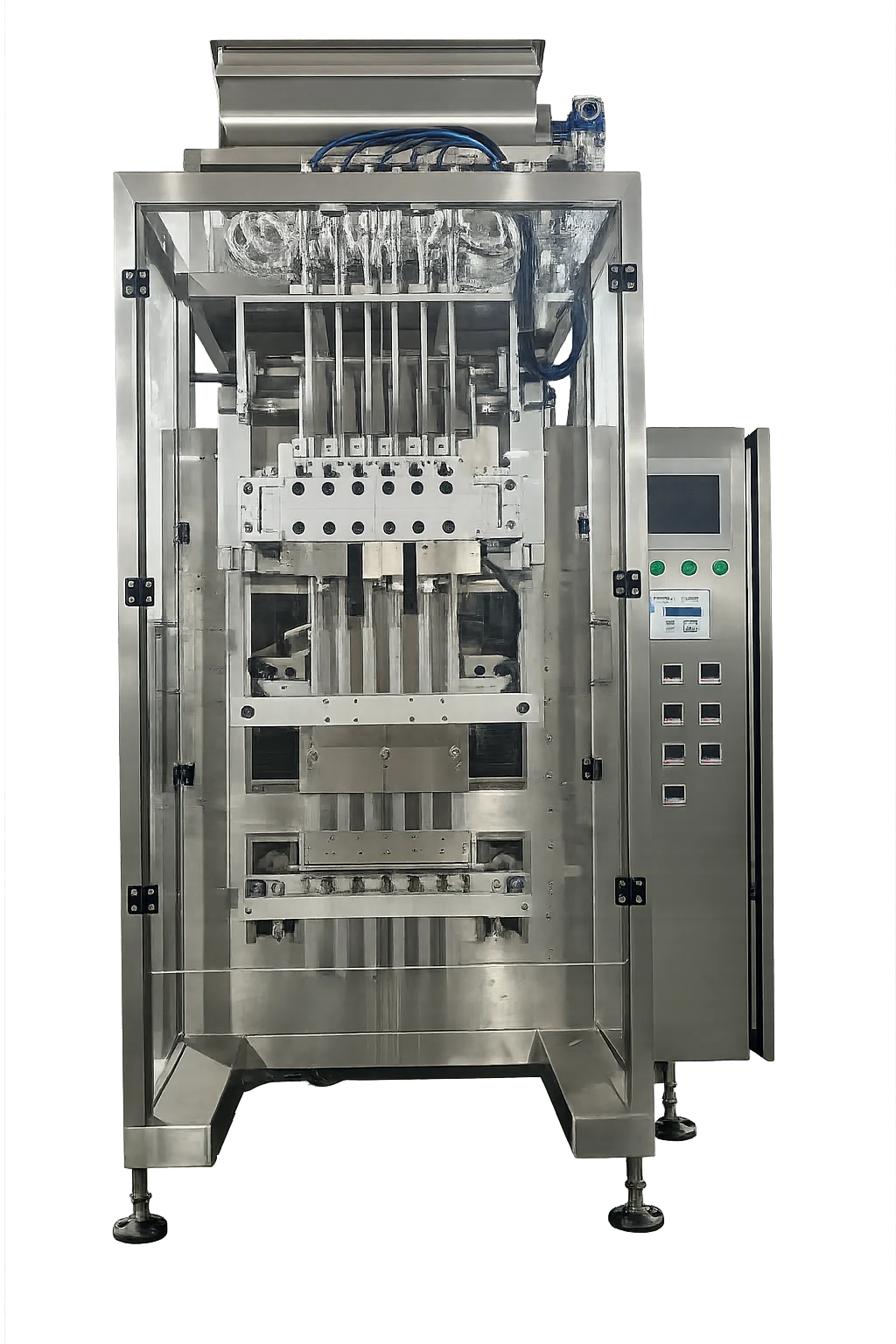
Create a sampling matrix before the demonstration. Include every active lane and the relevant stages of operation, such as established running, hopper replenishment, a planned restart or another condition agreed in the protocol. Select sample numbers and intervals with the customer's quality or statistical team; one convenient count is not a universal acceptance plan.
| Record field | Purpose | Example entry type |
|---|---|---|
| Product and lot | Identifies the formulation evaluated | Product code and sample lot |
| Lane and time | Separates spatial and time-related effects | Lane number and sampling time |
| Operating condition | Explains what happened during sampling | Steady run, replenishment or restart |
| Net result | Supports the defined fill assessment | Mass, unit and tare method |
| Intervention | Preserves changes that affect interpretation | Setting change or product adjustment |
Retain consecutive results where the protocol calls for them, including outliers and rejected packs. Replacing an inconvenient measurement with a better-looking sample destroys information. Identify exclusions, explain their reason and obtain agreement on how they affect the test conclusion.
6. Investigate powder feeding and density changes
For an auger-based powder filler, the relationship between delivered volume and mass depends on the product reaching the screw. Changes in bulk density, hopper presentation or discharge behavior can affect portion mass even when the nominal setting remains unchanged. This is a reason to evaluate the actual blend and feeding arrangement.
Watch for bridging, inconsistent replenishment, dust, buildup and product remaining in the transfer path. Ask whether a problem follows one lane, all lanes or a particular moment in the run. The pattern can help focus the investigation without assuming that every variation comes from an electrical setting.
Include representative formulations
Flavor variants, ingredient changes and different lots can alter powder behavior. For a sports nutrition project, identify recipes that represent the planned density and flow range. Review those samples with the supplier rather than using a free-flowing substitute to establish a general performance claim for the whole product family.
7. Review liquid and granule applications on their own terms
Liquid dose behavior can depend on viscosity at filling temperature, supply pressure, foaming, entrained air and nozzle cut-off. An interrupted supply or dripping nozzle can affect the pack even when the pump setting has not changed. Record temperature and relevant supply conditions beside the measurements.
Granules introduce questions about particle size, flow consistency and damage. A small number of comparatively large particles may produce discrete changes in pack mass. Evaluate the proposed dosing arrangement using representative material and the target portion, rather than assuming that a result from fine powder transfers directly.
Measure what the requirement actually specifies
If the product is specified by volume but checked by mass, establish how density and temperature enter the calculation. Do not use an assumed density without explaining it. COTECH's liquid and granule stick pack pages provide separate starting points for application discussions.
8. Interpret lane results without hiding the spread
Summarize each lane using the agreed measures, which may include sample count, mean, minimum, maximum and standard deviation. Keep a time sequence where it helps reveal drift or changes after replenishment. State how the statistics were calculated and distinguish descriptive results from the formal acceptance decision.
For a hypothetical example, lane A might have a mean of 10.02 g and lane B a mean of 9.98 g around a 10.00 g operating target. Their pooled mean can equal the target, but that does not establish either lane's individual-pack performance. You still need the measured spread and the agreed acceptance criteria.
Investigate before adjusting
A consistent lane offset and intermittent extreme results can have different causes. Review product supply, dosing components, timing and the measurement procedure. Record any adjustment and collect the required verification samples afterward. A final successful reading should not erase the earlier data or the explanation of what changed.
A small example: the same mean can describe different results
Consider two invented five-pack samples around a 10.00 g operating target. Lane A produces 9.90, 9.95, 10.00, 10.05 and 10.10 g. Lane B produces 9.99, 10.00, 10.00, 10.01 and 10.00 g. Both sample means are 10.00 g, but their ranges are 0.20 g and 0.02 g. The mean therefore does not tell the whole story.
Neither sample automatically passes or fails. That requires the agreed criteria and a suitable sampling plan. Five invented results are used only to explain the distinction, not to recommend a sample size or establish process capability. A customer should also know whether the measurements came from a stable sequence, a restart or selectively chosen packs.
Keep inline inspection and the reference method connected
If a checkweigher is included, agree how its indications and rejects will be verified against the reference method under running conditions. Establish whether lane identity remains traceable after sticks merge into a common conveyor. Losing that identity can make it harder to investigate a dosing difference that originates at one filling position.
Confirm the proposed inspection device's role, product presentation and reject arrangement. Detection of a lightweight pack, adjustment of a filling target and confirmation of net contents are different functions; their relationship must be defined for the purchased system. Do not assume automatic dosing feedback simply because a checkweigher appears in a line drawing.
Record how rejected samples are identified and retained during testing. Reconcile counts where required by the protocol, and distinguish a device's inspection result from the separate quality decision on the product. This preserves useful evidence when the equipment team reviews an apparent discrepancy.
9. Evaluate filling together with sealing and accepted output
A correctly weighed pack is not necessarily an acceptable finished pack. Product in the seal, poor opening, incorrect coding or leakage can still make it unsuitable. Assess weight results alongside the agreed pack-quality checks and use consistent definitions when reporting rejects and accepted production.
Reducing speed may improve one observation while moving the machine outside the buyer's production requirement. Conversely, increasing speed can change dosing or discharge behavior. Evaluate the combination of portion consistency, seal quality and accepted output at the agreed operating condition rather than approving each variable in an unrelated demonstration.
Use a connected acceptance protocol
The guides to stick pack film selection and factory acceptance testing address those complementary checks. Together, the records should show which product and film were run, what was measured, which interventions occurred and why the resulting configuration was accepted.

10. Transfer the tested method to the installation
Keep the approved settings, sample identification, measurement procedure and results with the equipment handover. Shipment inspection should confirm the agreed dosing components, accessories and documents. Installation preparation should cover the site's product supply, room conditions, measuring equipment and operator training.
Use an agreed startup verification to identify differences between factory and site conditions. A new product lot, different transfer equipment or a changed film can require review. Give operators a clear escalation path when lane behavior moves outside the established criteria, rather than encouraging undocumented adjustments to hide a developing problem.
Define change triggers
Identify which recipe, dose, contact-part, film or software changes require additional assessment. The aim is a repeatable decision process, with enough records to explain why the setting remains suitable for the current product application. A historical trial is useful only when its relevance to today's conditions is understood.
Frequently asked questions
What filling accuracy can a stick pack machine achieve?
The useful answer is product- and configuration-specific. Ask for results tied to the formulation, dose, measurement method, active lanes and operating condition. COTECH should review your actual requirements before any performance statement is agreed; a generic percentage cannot describe all powders, granules and liquids.
Why can the average look correct while some sticks are wrong?
High and low results can offset each other, especially when measurements from several lanes are pooled. Examine individual results, each lane's center and spread, and changes over time. The overall mean alone does not describe the performance of every finished pack.
Should we weigh the whole filled stick?
Gross weight can support a defined inspection method, but net contents exclude the wrapper. Establish a representative tare procedure and understand its uncertainty. Film and cutting variation, residual product and inconsistent sample preparation can affect the calculated result.
How many packs should we test per lane?
Agree the count and sampling intervals with the customer's quality or statistical team according to the purpose, risk and acceptance method. Include every active lane and relevant operating stages. A short demonstration sample is not automatically a production acceptance plan.
Does stable fill weight prove ingredient uniformity?
No. Net mass does not show how each ingredient is distributed within a blend. Product composition, segregation and ingredient uniformity require their own assessment by the product manufacturer. Keep those quality questions separate from the machine's measured portion consistency.
Can increasing the fill setting solve variation?
A higher setting can shift the mean but may leave the underlying spread, intermittent shortages or lane difference unresolved. Investigate the product, measurement and dosing process first. Set the operating target using the agreed quality requirements rather than using extra product to hide instability.
Conclusion: make accuracy a traceable test result
A defensible filling assessment starts with defined criteria and a reliable measurement method. Preserve net-content calculations, lane identity, time and operating conditions, then evaluate the results alongside sealing and accepted output. This makes the trial useful for both equipment purchasing and installation preparation.
Bring the customer requirements, product samples and proposed acceptance method into the same discussion with COTECH. The resulting test scope can then address the actual formulation and production task instead of relying on a broad accuracy statement with no supporting conditions.
Define a filling trial for your actual product
Send COTECH your powder, granule or liquid specification, target portion, proposed stick size and accepted output requirement. Include the fill criteria and measurement method you want evaluated, so the team can discuss a relevant dosing configuration and trial scope.
Send Your Requirements