
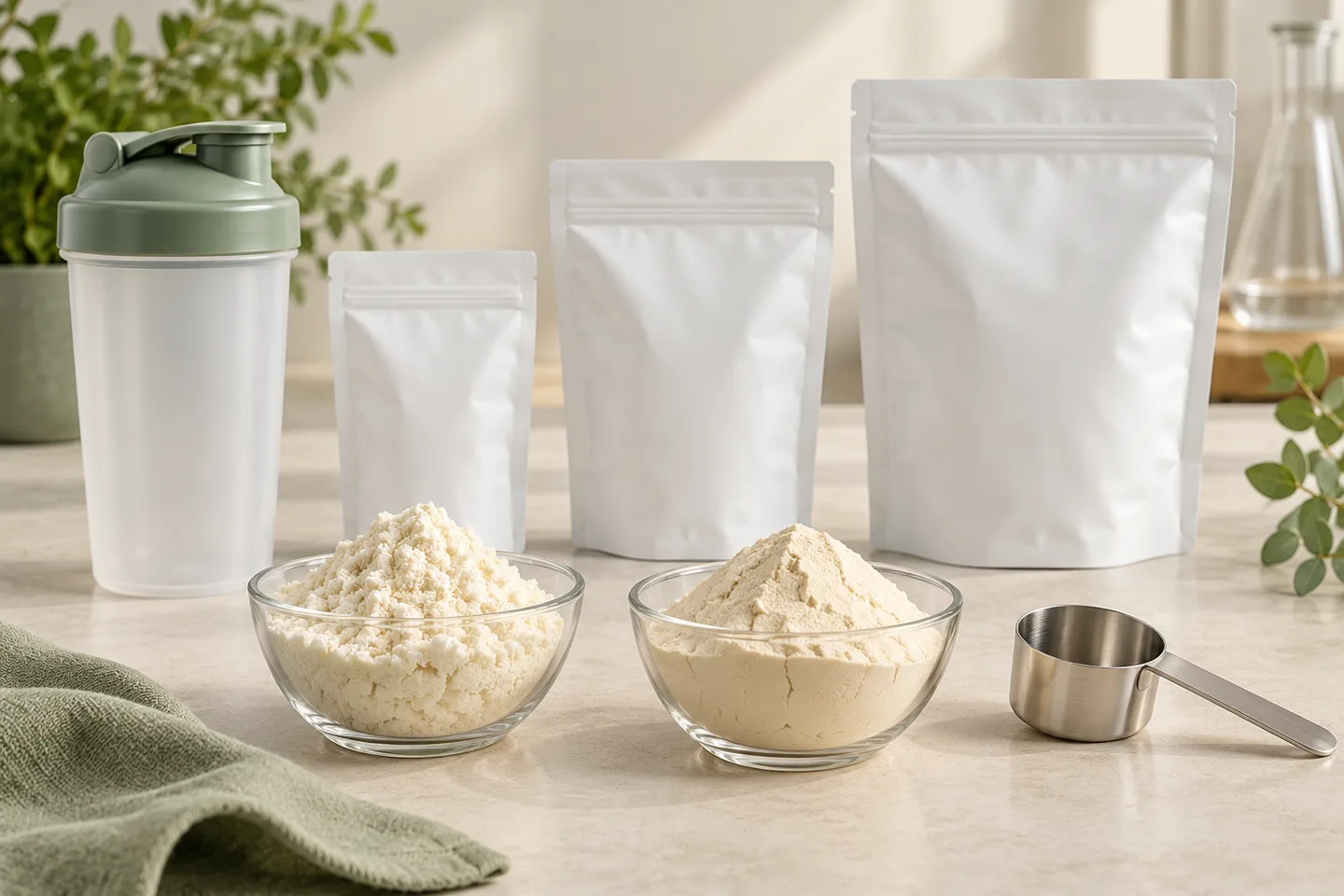
Introduction: can your protein serving fit a stick pack?
A protein powder stick pack machine should be selected around serving volume, powder behavior and usable pack dimensions. Serving weight alone is insufficient: a low-density blend can require considerably more space than another recipe at the same mass. Establish the actual product volume, evaluate filling and sealing, then compare a stick format with a wider sachet where necessary.
Protein brands and contract packers often begin with a convenient single-serving concept. The engineering question is whether that concept can hold the full formulated portion, remain clean at the seals and pour into the consumer's shaker without unnecessary effort. Those conditions affect pack design as well as equipment selection.
COTECH's powder stick pack equipment provides a starting point for this discussion. This guide explains the customer requirements to establish before requesting a configuration. Its numerical examples are hypothetical planning calculations, not verified COTECH fill ranges or nutrition recommendations.
1. Define the complete serving before choosing the pack
Distinguish the mass of finished powder from the amount of protein declared in a serving. Flavoring, sweeteners, minerals and other ingredients contribute to the formulated portion and its physical properties. The packaging equipment handles the complete blend, not an isolated nutrient value printed on the label.
Record every recipe and serving weight planned for the machine. A range including whey, plant protein and recovery blends may have different flow and cleaning requirements. Include the smallest and largest portions, but do not assume those two products also represent the most difficult handling conditions.
Connect the portion to the consumer task
Explain whether the powder is poured into a shaker, mixed in a glass or added to another food. The opening needs to suit that task, and the package must provide enough room for filling and dispensing. A competitor's attractive narrow stick is a useful visual reference, not evidence that your larger or fluffier serving will fit the same dimensions.
2. Measure bulk density and estimate serving volume
Bulk density relates the mass of a powder to the volume it occupies under a stated measurement method. Loose and tapped measurements describe different conditions. Ask the product or ingredient team to provide the method, results and normal variation, rather than treating one supplier's nominal value as an exact characteristic of every finished blend.
The Tetra Pak Dairy Processing Handbook identifies bulk density as relevant to powder handling and packaging. That principle helps explain why serving volume matters, but data for a particular dairy ingredient cannot automatically characterize a flavored protein recipe containing several ingredients.
A transparent volume calculation
For a hypothetical 25 g portion at a measured loose bulk density of 0.25 g/mL, the estimated loose volume is 100 mL: divide 25 by 0.25. At 0.50 g/mL, the same mass occupies 50 mL. These invented values illustrate the calculation; they are not typical specifications assigned to all whey or plant proteins.
This is an initial volume estimate, not a finished-pack drawing. Allowance is still needed for the actual forming geometry, product discharge, air, seals and usable opening. Confirm the concept through pack samples and trials rather than calculating a flat rectangle's apparent capacity.
A practical comparison: the same mass in two recipes
Suppose a buyer plans two hypothetical 25 g blends. Recipe A has a measured loose density of 0.25 g/mL and recipe B measures 0.40 g/mL using the same method. Their initial volume estimates are 100 mL and 62.5 mL. A drawing developed around recipe B therefore cannot be accepted for recipe A solely because the serving masses match.
Next compare how those powders reach the filler. A sample measured directly from a container may present differently after transfer, vibration or holding. Record the condition represented by each density value, and ask which product states the packaging trial should cover. Do not choose the densest measurement merely because it makes a preferred narrow format appear feasible.
Use physical packs to resolve the remaining questions
Prepare representative filled samples or a suitable trial rather than relying on a simple volume calculation. Check whether the forming arrangement admits the portion cleanly, whether the product settles away from seals, and whether the customer can dispense it through the opening. Confirm that the artwork and tear feature remain useful at the resulting dimensions.
If the stick becomes impractically long or wide, compare a sachet route with the same portion and acceptance requirements. Record the tradeoffs in opening, handling, film and production rather than presenting a format change as a failure. The application review should identify a practical single-serving package, not defend a shape selected before the product was assessed.
3. Compare the stick with a wider sachet honestly
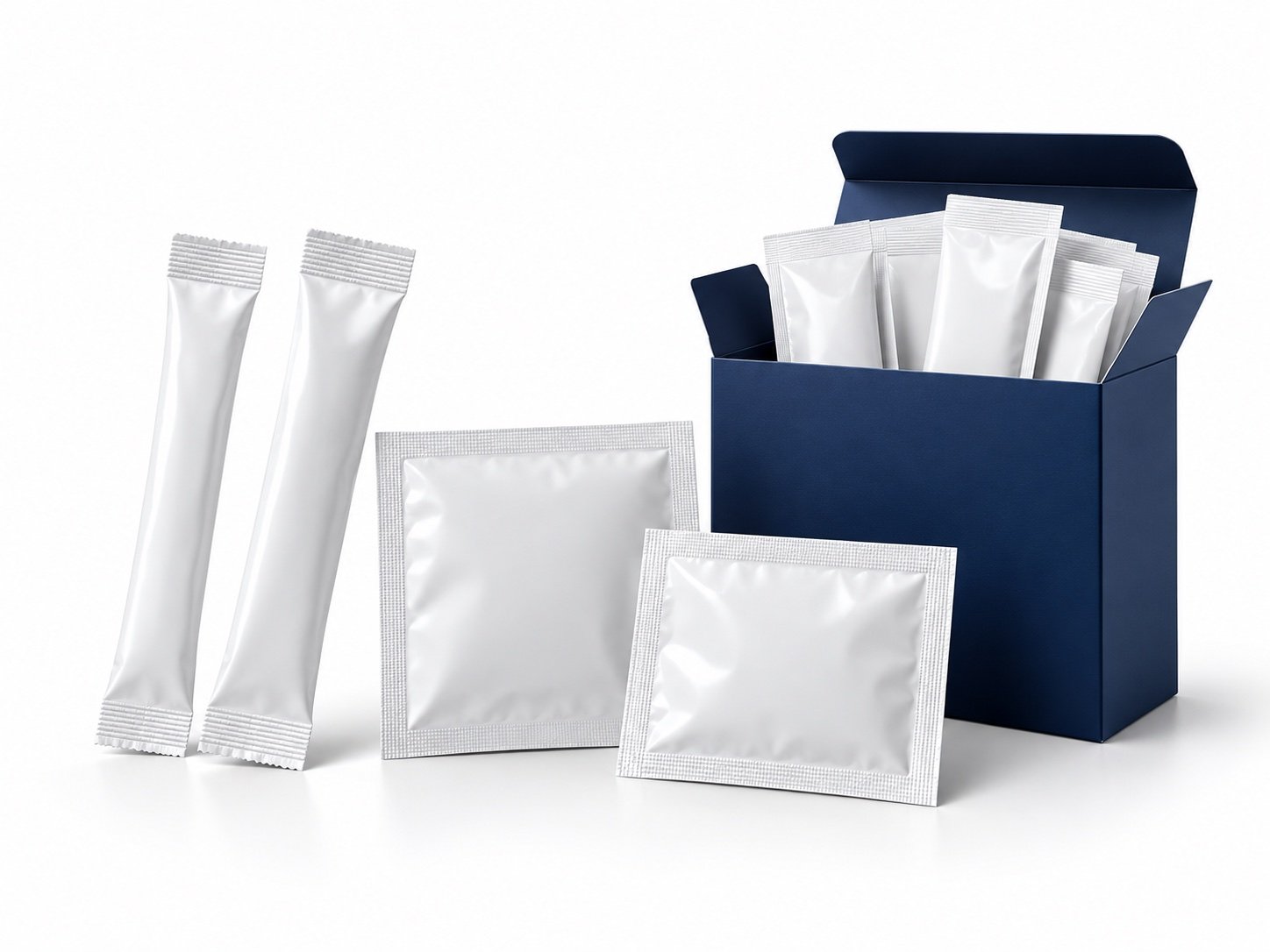
A slim stick can offer convenient portion handling when the recipe and dose suit its usable volume. A wider sachet may provide a more practical route for a bulky serving or a different opening requirement. Neither format is automatically better; the comparison should preserve the same formulated portion and quality requirements.
| Question | Stick pack review | Wider sachet review |
|---|---|---|
| Serving volume | Does the powder fit with a clean sealing area? | Does the wider format accommodate the portion efficiently? |
| Consumer use | Can the portion pour through the planned opening? | Is a broader opening useful for the intended vessel? |
| Film and artwork | Are seals, opening and information positioned correctly? | Does the larger face suit the design and handling? |
| Production | Can the purchased configuration dose and seal the product? | What filling and format arrangement is proposed? |
Compare physical prototypes using representative powder. For an alternative format discussion, review COTECH's sachet packing machines alongside the stick proposal. Do not reduce a serving solely to make an existing machine format appear suitable unless the product owner independently approves a new formulation and consumer offer.
4. Match the feeder and auger to the actual blend
An auger-based filler is often considered for protein powders, but specifying an auger is only the beginning. The product supplied to the screw, its packing behavior and the discharge path influence what reaches the pack. Review hopper replenishment, possible bridging and the way the blend changes during a production run.
Powders can settle, aerate or accumulate on surfaces. A setup that works with a freshly filled hopper may behave differently near replenishment or after a stop. Include relevant conditions in the sample trial, with lane identity and operating changes retained in the measurement record.
Do not confuse fill mass with blend uniformity
A consistent total portion does not prove that every ingredient is distributed uniformly. Segregation and formulation homogeneity require assessment by the product owner. Keep those checks distinct from the machine's fill-weight evaluation, and explain any product-handling restrictions that could influence transfer, agitation or the time spent in the hopper.
5. Assess dust, transfer and the available seal area
Fine protein powder can create dust during transfer and discharge. Product reaching the seal area can affect pack integrity even if the measured portion is acceptable. Observe the complete path from product supply through the forming section, rather than evaluating the dosing device in isolation.
Discuss the proposed dust-management approach and its compatibility with the formulation. Any extraction arrangement should be reviewed for the actual material and installation; removing airborne powder must not introduce an unexplained change to the blend or the amount delivered. Relevant material hazards belong in the project specification and technical assessment.
Evaluate the settled pack as well as the fresh fill
Inspect packs immediately after filling and after normal handling or settling. Check whether powder remains near seals, whether a long filled column obstructs opening, and how the portion empties. These observations help distinguish a useful consumer package from a pack that only appears to fit during a short demonstration.
6. Specify film protection, opening and compatibility
The formulation owner and converter should define relevant moisture, oxygen, light and product-contact requirements. Different protein blends can contain different oils, flavors and other ingredients. Avoid assuming that a film suitable for one product automatically establishes the stability or seal performance of another.
Give the equipment supplier the proposed structure, thickness, roll specification, print-registration information and opening design. The stick pack film guide explains how to connect material data with machine trials. Evaluate the actual product and laminate together, including contamination near seals and how the customer tears and pours the portion.
Separate protection from a shelf-life claim
A barrier datasheet is useful input, but finished-pack stability requires product-specific evidence under defined conditions. Gas flushing, if proposed for the application, also needs a clear purpose and agreed evaluation. It does not compensate for poor seals or establish a universal shelf life for every protein powder.
7. Plan flavor, ingredient and format changes
A sports-nutrition producer may change flavors often, while a contract packer may also change protein sources and portion sizes. Write a product-and-format matrix that identifies shared contact parts, cleaning requirements, packaging materials and verification steps for each transition.
Review access to the whole product-contact path, including upstream transfer components. Cleaning effectiveness and release criteria belong to the product owner's approved program, with the equipment manufacturer's instructions defining permitted methods. Stainless construction alone does not establish that an assembly can be washed down or cleaned by circulating liquid.
Evaluate the time until the next accepted pack
A meaningful changeover includes material clearance, cleaning where needed, reassembly, film setup, dose adjustment and restart checks. Use the companion cleaning and changeover guide to distinguish these tasks. A brief mechanical adjustment is not evidence of a completed product change.
8. Size output around the product schedule and sales unit
Translate customer demand into accepted portions per shift, then describe available production time and the number of recipe changes. Include how sticks are grouped into cartons or outer pouches. Primary packaging capacity is useful only when the product supply and downstream operations can support the same plan.
For a hypothetical order of 1,500 sales units containing 12 portions each, the requirement is 18,000 accepted packs. If the planned production window is 300 minutes, that is 60 accepted packs per allocated minute. This is demand arithmetic, not a COTECH machine speed specification.
Compare the same application conditions
Ask which active lanes, serving weights, pack dimensions and film underpin an output proposal. A successful run of a smaller, denser powder portion cannot establish the rate for a bulky protein serving. Record startup, replenishment, rejects and interventions so a running demonstration can be interpreted alongside the actual production schedule.

9. Build a representative protein powder trial
Supply samples identified by recipe and lot, plus film and the agreed pack drawing. Include representative difficult recipes, not only the product that pours most easily. Agree the test purpose, sampling plan and acceptance criteria before the demonstration so that both teams know what the results will establish.
- Confirm that the complete portion fits the usable pack.
- Record net fill results by lane and relevant operating stage.
- Observe product transfer, dust, bridging and replenishment.
- Check seals, coding, opening and portion dispensing.
- Measure accepted output with interruptions and rejects identified.
- Review the planned recipe change and restart requirements.
Retain unsuccessful samples and settings alongside the successful condition. If a different screw, film or format is proposed after testing, identify the change and the evidence needed to evaluate it. The final configuration should be traceable to the observations rather than inferred from a promotional video.
10. Connect the trial to shipment and site preparation
Before shipment inspection, reconcile the accepted configuration, supplied format parts, spares and documents with the purchase scope. Keep recipes, film identification, relevant settings and the measurement method in the handover record. These details help the receiving team understand what was actually demonstrated.
Installation preparation should address product supply, room conditions, required utilities, cleaning space and operator access. Include appropriate measuring equipment and enough representative product and film for startup. A different product lot or handling arrangement at the destination should be documented and reviewed where it changes the basis of the factory result.
Prepare a useful quotation brief
Bring purchasing, production and the product owner into one discussion. Provide the formulation range, portions, measured densities, proposed formats and shift target, then identify what remains undecided. An honest open question is more useful than an unsupported requirement that one machine must handle every future protein product at the same speed.
Frequently asked questions
Can protein powder be packed in stick packs?
Selected formulations and portions can be suitable after evaluation. The key questions are serving volume, powder flow, pack dimensions, sealing and dispensing. A bulky portion may be better suited to a wider sachet. Confirm suitability using your complete blend rather than a generic protein powder description.
Can a stick pack hold a full protein serving?
There is no universal answer from serving weight alone. Estimate volume using measured bulk density, then assess the actual formed pack and sealing allowance. A hypothetical 25 g serving at 0.25 g/mL occupies 100 mL before additional packaging considerations; this is an illustration, not a standard serving specification.
Should whey and plant protein use the same settings?
Do not assume so. Finished recipes can differ in density, flow, dust, flavor carriers and cleaning needs. Evaluate representative blends and retain the settings and conditions associated with each accepted configuration. Ingredient-family names do not provide enough information to guarantee identical behavior.
Does accurate pack weight prove protein-content uniformity?
No. Total mass and ingredient distribution are different quality questions. The product owner needs an appropriate assessment of formulation homogeneity and segregation. A filling trial should evaluate the agreed portion requirement without claiming that a correct weight proves every nutrient concentration.
Is an auger filler always the right choice?
An auger is often a starting point for powder discussions, but its suitability and configuration depend on the product. Assess feeding, screw geometry, discharge, density variation and the portion range through technical review and representative trials. Do not select the filler from a product name alone.
What should we send COTECH for a protein packaging review?
Provide complete recipes or relevant physical specifications, target portions, density measurements, pack dimensions, film and accepted output. Add the sales-unit count, changeover schedule and installation conditions. The sports nutrition application page provides another starting point for the discussion.
Conclusion: qualify the serving before committing to the format
A protein powder stick pack project succeeds when the complete portion, powder handling and consumer use fit the proposed package and equipment. Start with measured volume and representative recipes, compare stick and sachet routes where appropriate, then evaluate filling, seals, opening and accepted production together.
Keep the tested configuration and assumptions identifiable through purchasing, shipment and installation. That gives COTECH and the buyer a shared basis for selecting equipment around the actual application instead of promising that any protein serving will fit any narrow pack.
Check your protein powder and pack concept together
Send COTECH representative protein blends, serving weights, measured bulk densities, proposed pack dimensions and accepted output requirements. Include your film, cleaning needs and sales-unit format so the team can discuss a suitable machine and product-trial scope.
Send Your Requirements