
Introduction: what feeds a powder stick pack machine?
A powder stick pack machine needs a defined material path from the incoming container to the dosing hopper and into the pack. Select transfer and refill arrangements using powder behavior, consumption, exposure limits and installation constraints. An auger filler meters material presented to it; it does not automatically solve bridging, inconsistent replenishment or changes created by upstream handling.
For overseas buyers, this distinction matters when comparing quotations. A proposal can include a packing machine while leaving bag unloading, transfer, supports and utility connections outside supply. Those interfaces remain necessary even if the machine photograph looks complete.
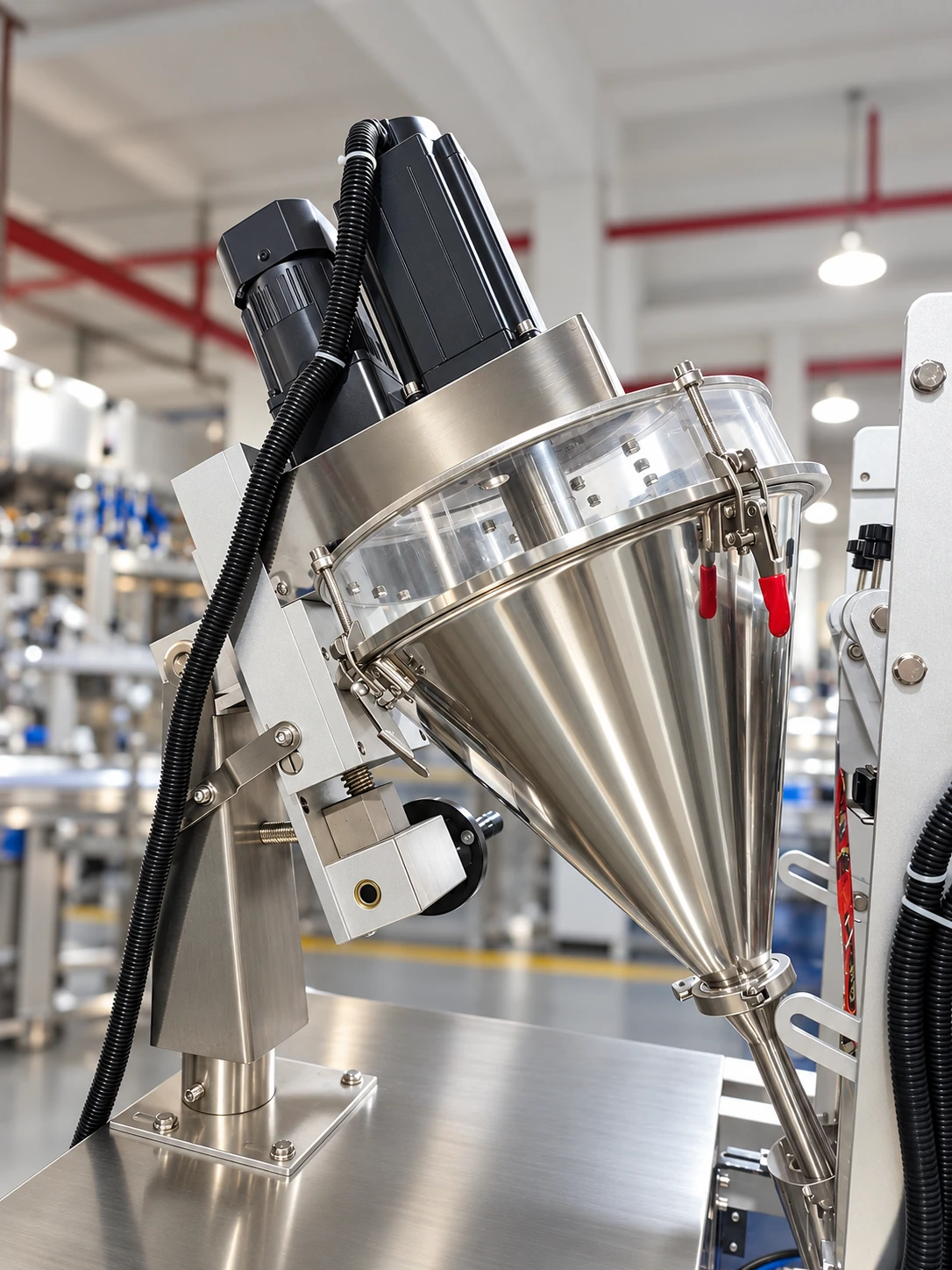
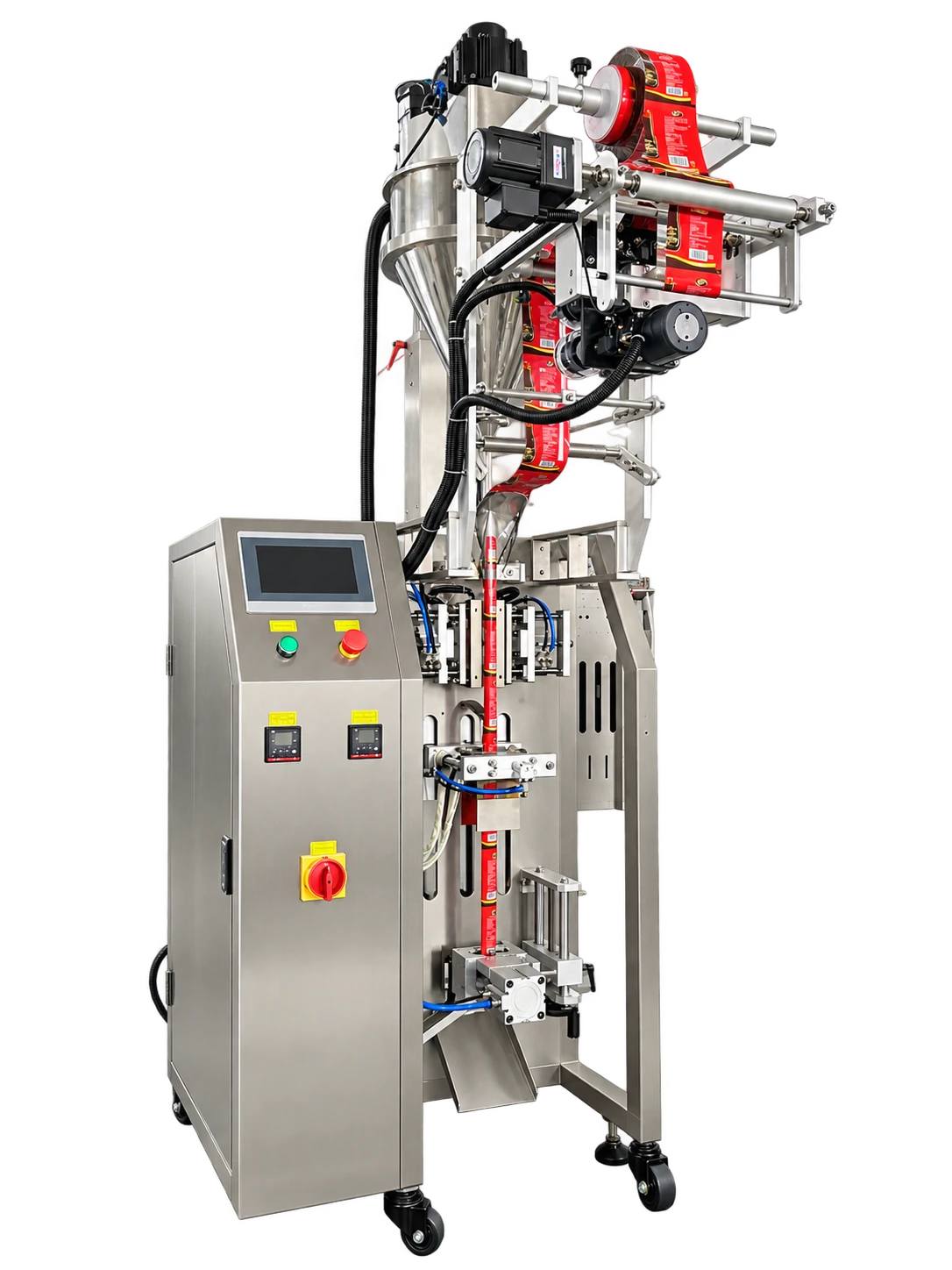
The pictured COTECH single-lane powder stick pack machine uses an auger hopper and one forming lane. Use its actual configuration as a starting point, then specify the upstream equipment separately where required. This guide concerns feeding-system selection; the companion filling accuracy guide addresses how finished portions are measured and assessed.
1. Draw the complete material path
Start at the container received by production: sacks, drums, lined bins or another approved format. Identify how it is opened, supported, emptied and connected to the next operation. Include screening or other preparation only where the product process actually requires it, and allocate its supply and verification.
Continue through every transfer point, intermediate container and connection to the packer. Mark where powder is exposed, where material can remain after a run and where operators need access. A simple flow sketch can reveal responsibilities that a general equipment list leaves ambiguous.
Define the machine interface
Ask for the relevant connection drawing and installation envelope rather than estimating them from a photograph. Confirm allowable loading, access, support and any proposed level information with the equipment suppliers. A hopper lid does not establish that arbitrary external equipment can be attached to it.
Also define the output of the upstream system. The packer needs powder arriving in an appropriate condition and at a sustainable rate, not simply a transfer device with a large advertised maximum throughput.
2. Describe the powder after handling, not only before it
Provide relevant particle information, bulk-density measurements, flow observations and sensitivity to moisture or mechanical handling. Include the measurement conditions and variation between lots. A single value taken from a raw ingredient datasheet may not describe the finished blend at the filler.
Coperion's feeding technology overview identifies particle characteristics, density, compressibility, cohesion and environmental behavior as material-selection inputs. Those principles explain why a product name alone is insufficient. Its particular feeder designs and performance claims should not be treated as COTECH specifications.
Preserve the conditioning history
Record whether trial powder was freshly blended, transported, held or transferred before use. Handling can change how a powder occupies space and reaches the dosing device. A successful test with gently hand-loaded material does not establish performance after a different transfer process.
For blended powders, keep ingredient distribution distinct from total portion weight. A stable mass result cannot independently establish that a transfer route preserved formulation homogeneity. That question belongs in the product owner's evaluation.
3. Recognize different flow patterns
Bridging, restricted flow and uncontrolled discharge are different observations. In a bridge, material can form an obstruction above an outlet while the dosing area below becomes starved. In channel flow, some material can move while other material remains around it. An aerated powder may instead discharge more freely than intended.
Kubota's material-feeding explanation distinguishes bridging, rat-holing and flushing as different handling problems. These categories are useful for describing behavior; they do not identify the correct corrective device for your installation.
Do not select agitation from a symptom label
Vibration, agitation or another flow aid needs a technical assessment of the actual material and equipment. An intervention that improves one powder's discharge can change compaction or segregation in another. Request evidence for the proposed arrangement rather than specifying an unqualified cure.
During observation, follow approved operating procedures. Opening guards or reaching into equipment to obtain a better view is not part of a buyer's assessment. Ask suppliers to provide appropriate observation and maintenance access in their design.
4. Compare transfer routes within the application
Manual loading, gravity transfer, a screw conveyor and pneumatic or vacuum transfer describe different material paths. None is universally best. Review handling effects, operator tasks, access, cleaning and the interface with the packer's hopper before comparing purchase prices.
| Route | Application question | Scope to clarify |
|---|---|---|
| Manual loading | Can the planned containers and refill frequency be managed appropriately? | Access, handling aids and operator tasks |
| Gravity connection | Will material flow consistently under the actual holding conditions? | Supports, outlet arrangement and residual material |
| Screw transfer | How does transfer affect the blend and discharge condition? | Contact path, cleaning access and control interface |
| Pneumatic or vacuum transfer | What happens to aeration, separation and receiver discharge? | Receiver, filtration, utilities and refill sequence |
Ask which equipment is included, optional or supplied by another party. The presence of an auger at the filler does not establish that a matching upstream conveyor is included. Connect each proposed route with a representative product trial.
5. Calculate consumption and useful buffer time
Express consumption using the agreed portion and production basis. For an invented example, 10 g per accepted pack at 45 accepted packs per minute corresponds to 450 g per minute, or 27 kg per hour. Additional product may be needed for startup, rejects or other losses. The example is planning arithmetic, not a COTECH speed or dose specification.
If an illustrative usable powder buffer is 1.5 kg, dividing by 0.45 kg per minute gives approximately 3.3 minutes before that amount is consumed. This is not a recommended refill interval. The usable buffer, operating reserve and refill sequence must be established for the actual system.
Distinguish nominal volume from working material
A hopper's geometric volume is not the same as an approved working mass. Product density, discharge behavior, level limits and retained material affect usable capacity. A larger hopper may also increase hold time or loading, so more volume is not automatically a better answer.
Check whether upstream supply can replenish the system under its agreed operating conditions without creating a recurring stop at the packer.
6. Treat a refill as an operating event
Describe when replenishment starts, what transfers, how it stops and what the filler does during the event. Establish responsibility for any level information, permissives or stopping behavior. Do not assume that two independently quoted devices already exchange the necessary information.
Observe the product condition immediately before, during and after refill. A freshly added quantity can change the powder presented to the screw. Record associated settings and samples so a stable period is not mixed with a different refill condition in one summary result.
Include interruptions
Review the response to an empty source container, a delayed operator or an interrupted transfer. Ask how an incomplete refill is recognized and how restart is controlled. These are interface requirements to resolve with the suppliers, not instructions to improvise control changes on installed equipment.
Keep the commercial production schedule visible. A transfer arrangement that works in a brief demonstration may still require more operator attention than the buyer allocated for routine orders.
7. Review exposure, retained powder and cleaning access
Mark open transfer points and estimate how long material remains exposed or held within the system. Where the formulation is moisture-sensitive, coordinate the handling plan with the hygroscopic powder packaging guide. A suitable finished-pack barrier does not protect powder before the pack is sealed.
List contact components and locations where residue can remain after discharge. Explain who opens, cleans, inspects and reassembles them using approved procedures. Do not infer washdown, clean-in-place capability or an approved cleaning method from stainless construction alone.
Assess the whole contact path
The upstream receiver or connector may require different access from the auger hopper. Compare the transition between recipes as a complete process, not a quick adjustment of the filler. The product owner's cleaning and material-release program needs to cover the full route.
Ask competent specialists to review relevant material hazards and installation requirements. A feeding article cannot specify a universal dust-control or protection arrangement for every powder.
8. Test the feeding and packing combination
Agree what factory testing can realistically represent. If the purchased transfer route is available, use it with identified product, film and pack dimensions. If only manual loading is demonstrated, state that limitation and identify which upstream questions remain for later evaluation.
- Identify product lots, handling history and relevant material measurements.
- Record source-container changes and hopper refill events.
- Observe material buildup, retained powder and inconsistent discharge.
- Measure agreed finished-pack characteristics and accepted output.
- Keep interruptions, rejects and operator interventions in the run record.
- Identify configuration changes and the evidence needed afterward.
For a multi-lane proposal, retain lane information as well as the shared supply record. The single-lane machine pictured in this article does not establish a multi-lane distribution arrangement. Higher-output projects require a separate configuration review.
Keep a practical observation log
Use a timeline connecting material events with collected samples. It helps determine whether variation coincides with refill, a source-container change or another operating event, without assuming that timing alone proves the cause.
A practical comparison: manual loading versus a proposed receiver
Consider a hypothetical buyer whose powder packs acceptably when small quantities are loaded by hand. The buyer then proposes a receiver feeding a larger amount at intervals. That proposed route changes more than operator effort: it changes the material's handling history, replenishment pattern and equipment interfaces.
Keep the original hand-loaded condition as a documented reference. Describe the proposed receiver, connection and operating sequence without assuming the packing machine already supports them. Ask which samples and observations are needed to compare the conditions meaningfully.
Preserve the application boundary
If the receiver is unavailable during a trial, record the uncertainty in the acceptance plan. Do not convert a successful manually supplied demonstration into an unqualified approval of the untested transfer system. Allocate the remaining evaluation to the responsible supplier or destination team.
The comparison may still support a useful equipment decision. Its value comes from identifying what was demonstrated and what remains open, rather than presenting all powder supply routes as equivalent.
9. Assign interface and delivery responsibilities
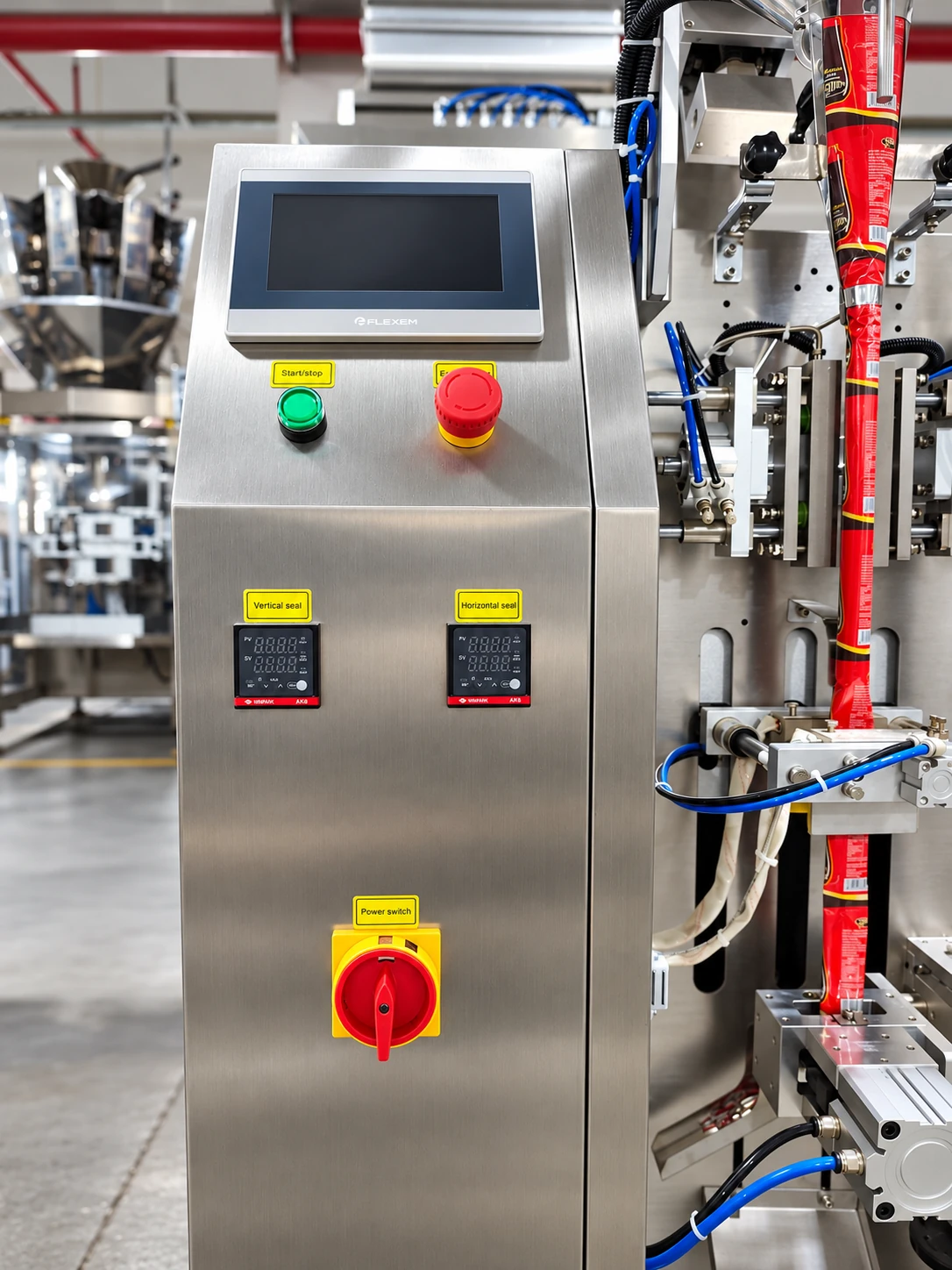
Create a responsibility list for mechanical connections, supports, wiring, utilities, cleaning access and commissioning. Identify the party that verifies the combined function. Equipment from two suppliers can each meet its individual quotation while leaving an unresolved connection between them.
Before shipment inspection, reconcile the packing-machine configuration and supplied connection parts with the accepted drawings. Keep the product, film and relevant settings associated with the trial. Identify components supplied separately and confirm when the destination team will receive them.
Prepare the destination process
Installation preparation should cover source-container handling, available height, service space, utilities and the people needed for the first run. Provide representative powder and film in quantities agreed for startup and verification.
If destination transfer or holding conditions differ from the factory demonstration, document that difference. Settings are a useful reference for a defined condition, not a guarantee that changed powder supply will behave identically.
10. Give suppliers a decision-ready feeding brief
Combine the material profile, flow sketch, consumption calculation and interface list into one controlled brief. Distinguish confirmed requirements from ideas still under review. A simple bag-loading arrangement and a proposed automated route can be quoted as alternatives if the application boundaries remain explicit.
Ask the proposal to state assumptions about powder condition, loading and usable hopper operation. Require unresolved items to remain visible. A checked box marked automatic feeding is less informative than a description of what equipment transfers material, how it interfaces and who verifies the result.
Use evidence to choose the next step
The most useful response may be a request for representative samples or an additional handling assessment. That is a concrete way to reduce uncertainty. Compare such a response with evidence from other proposals rather than favoring an unsupported assurance that any powder will flow.
Ask how the interface will be accepted
For each connection, state the evidence needed before handover: a drawing review, a confirmed component list, an operating demonstration or an agreed destination check. Identify who provides that evidence and who accepts it. This prevents a supplier's general statement that equipment is compatible from standing in for an evaluated connection.
Keep the powder's condition at the interface in the same record. Mechanical fit alone does not establish adequate supply, appropriate exposure or repeatable discharge. A complete enquiry therefore describes both the hardware boundary and the material presented at that boundary.
Frequently asked questions
Does an auger filler include automatic powder transfer?
Not necessarily. The auger meters powder at the filler. Bag unloading, conveying, receiving, supports and controls can be separate scope items. Confirm the equipment list and interfaces in the quotation.
Is a larger hopper always better?
No. Usable buffer, material behavior, hold time, loading and cleaning access matter. Confirm an appropriate working arrangement for the actual powder rather than choosing only by nominal geometric volume.
Can vacuum transfer change filling behavior?
It can change the condition in which powder reaches the hopper. Assess the actual route, receiver discharge and replenishment sequence. Do not infer identical performance from a successful hand-loaded trial.
Can agitation solve every bridging problem?
No. Select any flow aid through technical review of the material and equipment. It may also influence compaction or blend behavior. A symptom label does not establish a universal corrective device.
What should be recorded during replenishment?
Record the source, timing, material condition, relevant machine state and associated samples. Link those observations with the run record so refill periods can be distinguished from stable operation.
What should we send COTECH first?
Send powder information, incoming containers, portion and stick drawings, accepted output and layout. Include the proposed transfer route and supplier boundaries. Ask for a review of the actual packing-machine interface.
Conclusion: specify powder supply as part of the application
A useful feeding plan connects the incoming container, transfer route, hopper and dosing device under defined material conditions. Calculate consumption, review refill events and test the combination that will actually be used. Keep supplier boundaries and untested conditions clear through purchasing, shipment and installation. That creates a stronger basis for selecting powder stick pack equipment than treating an auger photograph as a complete feeding solution.
Define the powder path before requesting equipment
Send COTECH your powder specifications, incoming container, portion, pack dimensions, accepted output and proposed room layout. Identify who supplies transfer equipment and utilities so the team can discuss the packing-machine interface and an appropriate product trial.
Get a Quote