
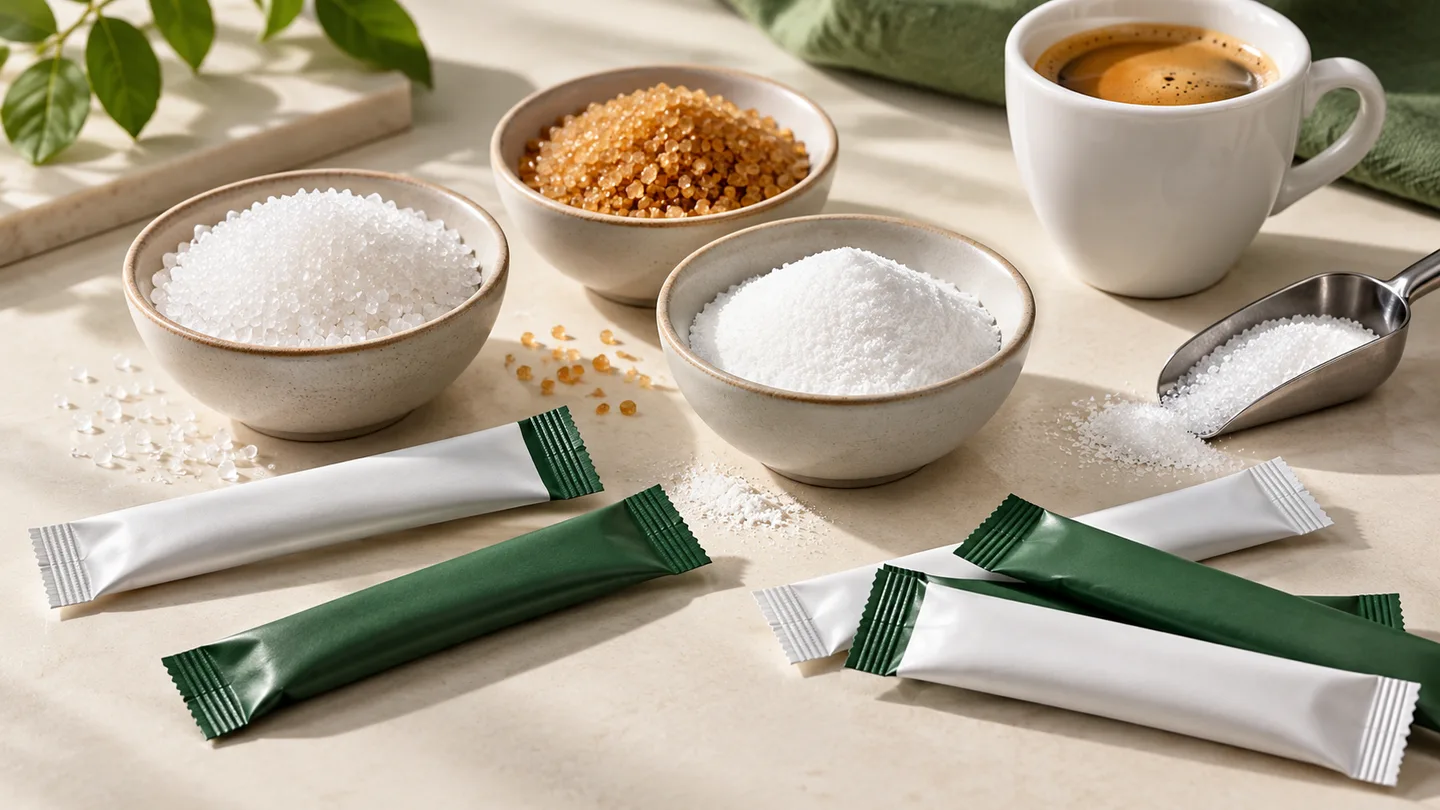
Introduction: what should a sugar stick packing machine handle?
Choose a sugar stick packing machine around the actual crystals or sweetener blend, the complete portion, usable stick dimensions and required accepted output. Free-flowing crystal sugar can be considered for volumetric dosing, while fine powders and mixed formulations may need a different filling arrangement. Confirm the route with representative product and film rather than assuming that every sweet-tasting ingredient behaves like granulated sugar.
Hospitality suppliers, sugar processors and private-label brands also need packs that open predictably and arrive in the correct outer quantity. A portion that meets its weight target but spills during opening or carries the wrong artwork is not an accepted saleable unit. The application review therefore needs to connect material handling, packaging and order fulfillment.
COTECH's granule stick pack machine page is a useful starting point. This guide develops the sugar-specific questions behind a quotation. It does not assign a universal fill range or speed to every product.
1. Separate crystal sugar, fine sugar and formulated sweeteners
Start with the supplied material, not the consumer-facing product name. White crystals, coarse brown crystals, powdered sugar and a carrier-based sweetener blend can differ in flow, fines, moisture condition and packing behavior. Even two deliveries with the same commercial description may have different particle distributions.
| Product family | Questions to establish | Trial emphasis |
|---|---|---|
| White crystal sugar | Crystal size, fines and consistency between lots | Repeatable filling and clean discharge |
| Brown or coarse sugar | Actual moisture condition, cohesion and particle size | Bridging, buildup and pack opening |
| Fine or powdered sugar | Dust, aeration and bulk-density variation | Feeding stability and seal contamination |
| Sweetener blend | Full recipe, carrier, portion and segregation risk | Blend handling and suitable dosing |
Do not specify a concentrated sweetening ingredient as though it were the finished retail portion. The machine handles the complete formulated blend. Give the supplier the physical information needed for selection while managing commercially sensitive formulation details through your normal purchasing arrangements.
2. Describe the particle profile through the whole feed path
Provide the particle-size information available from your product team, including the method and relevant variation. Photograph samples with an appropriate scale and identify their lot. A photograph alone cannot replace measurements, but it can make a discussion about coarse particles, fines or agglomerates more concrete.
Observe what happens after transfer. Material can separate, compact or generate additional fines between a bulk container and a filler. An apparently uniform scoop taken from the top of a freshly opened bag may not represent the product reaching every lane later in a run.
Include the difficult operating states
Explain how sugar arrives, how containers are emptied and how the hopper is replenished. Identify storage and room conditions that could change flow. Ask the technical team to review relevant dust and material-handling considerations for the actual installation; a generic reference to sugar does not establish that every transfer arrangement is suitable.
A useful trial compares stable production with replenishment and an agreed restart condition. Retain the context of each sample so that changes in fill weight can be interpreted alongside product supply.
3. Evaluate volumetric, weighing and powder-filling routes
A volumetric device meters a defined space. Its delivered mass depends on how the actual product occupies that space. This can be a practical route for a consistent, free-flowing crystal product, but the word volumetric is not a guarantee that changing sugar lots will leave the portion unchanged.
A weighing-based proposal addresses a different measuring principle, while an auger may be considered for an appropriate powder formulation. Each approach still depends on controlled feeding and a suitable discharge path. Ask what the quoted configuration measures, how it is adjusted and what variation was observed with your sample.
Read application examples as examples
Equipment manufacturer Mentpack describes volumetric and gravimetric options for sugar and sweetener applications. That illustrates why more than one dosing route may be discussed. Its listed configurations and performance claims are not COTECH specifications and should not be transferred into your quotation.
Compare proposals using the same formulation, portion and acceptance method. If a supplier recommends a different filler after testing, retain the reason and the resulting scope change.
4. Translate the complete portion into a usable stick
Specify net product mass separately from the dimensions of the finished package. The volume occupied by a portion depends on its bulk density and handling condition. The pack also needs space for discharge, seals and opening; apparent volume calculated from flat film dimensions is not a finished-pack capacity rating.
For an invented planning example, a 4 g portion at 0.80 g/mL occupies approximately 5 mL. At 0.50 g/mL, the same mass occupies 8 mL. These values demonstrate mass divided by density. They are not measured COTECH trial results, universal sugar densities or recommended consumer servings.
Check the opening with the intended customer
Evaluate how a user holds, tears and pours the stick into a cup. Coarse particles and a small tear opening may create a different experience from a fine blend. Include printed prototypes where artwork position, tear location and portion identification influence the hospitality or retail offer.
If the preferred shape is impractical, compare an alternative stick size or sachet without changing the product brief silently.
5. Keep the filling task separate from the sealing task
A correctly measured portion can still create a poor package if particles remain across the intended seal. Review the drop path, discharge timing and available settling space. Look at the filled pack rather than judging performance only from material delivered into an open collection vessel.
Record where contamination appears: the longitudinal seam, end seal or a fold. Distinguish a trapped crystal from a wrinkle or a film-handling defect. The observations guide an investigation; they should not become an unsupported instruction to increase temperature or pressure.
Evaluate fine material as well as visible crystals
Fines can behave differently from the larger particles seen in a sample photograph. Agree how dust and transfer will be managed and how rejected material will be handled. Equipment cleaning and adjustment should follow the manufacturer's procedures, with responsibilities identified before factory testing.

6. Specify film, artwork and product identification together
Ask the product owner and converter to define the required protection and product-contact suitability. The equipment discussion needs the laminate structure, thickness, roll dimensions, unwind direction, registration information and approved pack drawing. A material described only as paper or recyclable leaves important sealing and machine-interface questions unanswered.
Qualification concerns the finished combination of film, product and process. Use the stick pack film selection guide for roll and material questions, and the seal integrity testing guide for the evidence needed to evaluate closure quality.
Plan several brands without mixing them
A hospitality supplier may use the same sugar under multiple customer artworks. Keep product, roll and carton identification linked. Describe material clearance, coding approval and remaining-film handling at changeover. Correct pack weight cannot detect an incorrect logo, language or outer carton.
Include how retained samples and production records identify each order. This is an operating requirement as well as a printing requirement.
7. Calculate demand in accepted sticks and finished orders
Begin with confirmed sales units and the number of sticks in each unit. Then allocate realistic production time across recipes, artworks, cleaning and maintenance. The target is accepted output reaching the required outer pack, not a momentary machine cycle count.
Suppose an illustrative order contains 800 cartons with 500 sticks each. The requirement is 400,000 accepted sticks. Over an allocated 2,000 production minutes, that equals 200 accepted sticks per allocated minute. This arithmetic describes demand only; it does not establish how many lanes or which COTECH machine can meet it.
Include the route after primary packaging
Explain whether sticks are counted into cartons, supplied in bulk liners or grouped into another sales format. Identify who provides counting, inspection, rejection and case packing. If those operations cannot support the order rate, extra primary-packaging capacity may not shorten delivery.
Keep recurring short orders visible in the schedule. A machine proposed around one long sugar run may spend a very different proportion of the week producing saleable packs when artwork changes frequently.
A practical comparison: crystal sugar and a sweetener blend
Consider a hypothetical buyer launching a white-sugar stick and a fine, carrier-based sweetener stick. The buyer wants identical outside dimensions for a shared presentation box. That packaging preference is useful, but it does not establish identical portion volume, filling behavior or cleanability.
Prepare separate material rows: complete portion, density method, particle distribution, relevant product sensitivities and expected order pattern. Establish which parts of the proposed system are shared and which need adjustment, dedicated components or another configuration. A trial using only the easy-flowing sugar cannot establish suitability for the fine blend.
Keep unresolved decisions visible
If the sweetener formula is still changing, label its specification provisional. Ask what must be repeated when the final sample becomes available. Avoid accepting a blanket promise that any future sweetener can run at the demonstrated sugar output.
Compare the proposed transition, including clearance, cleaning, reassembly and restart checks. The resulting evidence is more useful than two unrelated promotional videos showing attractive finished sticks.
8. Build a representative application trial
Agree the trial objectives before shipping samples. Identify the product lots, film rolls, pack drawings, active lanes and proposed test conditions. Define the buyer's acceptance criteria and who will measure them. The supplier should know which questions remain open rather than discovering them after a demonstration.
- Check complete portion delivery by lane under agreed operating conditions.
- Observe transfer, hopper behavior, replenishment and product buildup.
- Inspect seal areas, opening, coding and print-to-cut position.
- Record accepted output, rejects, stops and relevant interventions.
- Evaluate the proposed artwork or recipe change and its restart checks.
- Keep results tied to the sample, film and machine configuration.
A short successful run is useful evidence for its stated conditions. Ask which questions require additional testing, another product lot or destination-site verification. Refer to the factory acceptance test guide when defining the wider handover.

9. Preserve the application through shipment and startup
At shipment inspection, reconcile supplied formats, product-contact components, spares and documents with the accepted configuration. Retain the product and film identification associated with the trial. A crate containing the agreed machine is only one part of a usable handover.
Installation preparation should cover material storage, transfer, utilities, working clearance and the people responsible for quality checks. Provide suitable representative product and film for startup. If destination conditions or incoming material differ from the factory trial, record that difference rather than treating the earlier settings as automatically transferable.
Give purchasing a decision-ready brief
Consolidate customer requirements into a product-and-order matrix. Separate confirmed portions, formats and volumes from forecasts and future options. Request an itemized configuration, exclusions and proposed evaluation plan. This gives competing quotations a common application basis without turning an uncertain future product into an unqualified machine requirement.
10. Qualify a finished order, not only a loose sample
Use one representative order specification to connect the machine trial with the buyer's delivery requirement. Identify the product lot, artwork revision, code information, stick count per outer pack and acceptance checks. A loose collection of attractive sticks does not demonstrate that the order can be identified and packed correctly.
For a hospitality project with several customer artworks, ask how the team verifies the first accepted pack after a roll change. Determine what happens to remaining printed film and partially completed cartons. These questions matter even when the sugar formulation and portion stay unchanged.
Keep quantity and weight checks distinct
A carton count and the net mass of an individual stick answer different questions. Define which operation verifies each requirement and how rejected packs affect the final count. A gross carton weight may provide supporting information, but it should not silently replace the agreed individual-portion or quantity assessment.
Retain a first-order checklist that the receiving team can repeat at startup: confirm material identity, inspect representative finished sticks, verify coding and review the outer-pack arrangement. Link any issues to their production stage. This creates a practical handover from sample evaluation to routine order release without claiming that a single demonstration qualifies every future artwork.
The purchasing brief should therefore include both a product sample and an order example. Together they explain what must flow through the machine and what the customer must ultimately receive.
Frequently asked questions
Can one machine pack white sugar and powdered sweetener?
Possibly, depending on the actual materials and purchased configuration. Free-flowing crystals and fine blends can need different dosing, feeding and cleaning arrangements. Evaluate both products and the transition; a successful white-sugar demonstration does not prove the sweetener application.
Is volumetric filling always suitable for sugar sticks?
It can be considered for a consistent, free-flowing product. Delivered mass still depends on how the material fills the metered space. Review lot variation, product supply and actual trial results before choosing the route.
Can we choose stick dimensions from portion weight alone?
No. Assess bulk density, usable formed volume, discharge clearance, seals and opening. Keep the full product portion unchanged while evaluating the format, unless the product owner separately approves a different consumer offer.
How many lanes are needed for a sugar order?
Translate demand into accepted sticks over the available production schedule, including changeovers and downstream packing. Then evaluate the proposed lane configuration using your product and film. There is no universal lane count for every sugar processor.
Should brown sugar use the same settings as white sugar?
Do not assume identical behavior. Assess the actual particle distribution, moisture condition, cohesion and required portion. Establish relevant settings and cleaning needs through the application review and representative samples.
What information should we send with an enquiry?
Provide product samples or physical specifications, complete portions, pack drawings, film and accepted order demand. Include artwork changes and the outer-pack format. COTECH's sugar and sweetener application page provides a related starting point.
Conclusion: specify the material and the finished order
A useful sugar stick equipment decision connects actual crystals or sweetener blends with dosing, clean seals, usable opening and accepted order output. Keep recipe and artwork changes visible, test representative materials, and carry the demonstrated configuration through shipment and installation. That creates a purchasing basis grounded in the intended application rather than a generic sugar-machine label.
Build a sugar and sweetener application brief
Send COTECH your actual sugar or sweetener samples, full portion weights, particle information, proposed stick dimensions and shift demand. Include film, recipe changes and outer-pack requirements so the team can discuss equipment scope and representative factory testing.
Get a Quote